🧰 Problem solverZones4 min read
When to plant garlic in zones 3 to 5: one to two weeks after the first frost
Quick answer
In zones 3 to 5, fall garlic goes in after the first frost, not before it. Minnesota Extension says one or two weeks after the first killing frost, and Wisconsin Extension says within a week or two of it. Maine's bulletin gives mid-September to the end of October, north to south. Look up your typical first fall frost, add one to two weeks, and that's your planting week: about October 15 to 22 in St. Paul and October 3 to 10 near Bemidji.
Source: University of Minnesota Extension, Growing garlic in home gardens, checked October 8, 2026; University of Wisconsin Extension, Garlic (A3785), checked October 9, 2026; University of Maine Extension, Bulletin #2063 Growing Hardneck Garlic in Your Maine Garden, checked October 9, 2026; NOAA 1991-2020 U.S. Climate Normals, annual/seasonal, checked October 7, 2026.

The goal
Roots this fall, leaves next spring
Cold-zone extension pages time garlic against the first hard freeze. Wisconsin Extension says planting a week or two after the first killing frost lets roots grow and shoots start inside the clove, without the shoots coming above the soil before the first hard freeze. Minnesota says the same: roots and shoots come out of the clove by the first hard freeze, but the shoots usually stay below ground until spring.
Source: University of Wisconsin Extension, Garlic (A3785), checked October 9, 2026; University of Minnesota Extension, Growing garlic in home gardens, checked October 8, 2026.
Maine's bulletin puts the risk plainly. Plant too early and the top comes up above the soil, where winter can injure it. That's the reverse of zones 6 to 7, where extension pages plant around the first frost. In these states you wait for it.
Source: University of Maine Extension, Bulletin #2063 Growing Hardneck Garlic in Your Maine Garden, checked October 9, 2026.
| Place (zone) | Nearest NOAA station | 1 in 10 first frost | Typical first frost | Plant (1 to 2 weeks after) |
|---|---|---|---|---|
| Bemidji, MN (3b) | Cass Lake | September 12 | September 26 | October 3 to 10 |
| Wausau, WI (4b) | Wausau Downtown Airport | September 21 | October 4 | October 11 to 18 |
| St. Paul, MN (5a) | U of MN St. Paul | September 25 | October 8 | October 15 to 22 |
| Madison, WI (5a) | UW Arboretum | September 26 | October 9 | October 16 to 23 |
Frost dates are NOAA 1991 to 2020 normals for the station nearest each zip code (32°F). The planting column adds 7 and 14 days to the typical date.
Source: University of Minnesota Extension, Growing garlic in home gardens, checked October 8, 2026; University of Wisconsin Extension, Garlic (A3785), checked October 9, 2026; NOAA 1991-2020 U.S. Climate Normals, annual/seasonal, checked October 7, 2026; NOAA 1991-2020 annual/seasonal normals documentation, checked October 7, 2026; PRISM 2023 USDA hardiness zone GIS datasets and zip-code listing, checked October 6, 2026.
- 1 to 2 weeksafter the first killing frost (Minnesota, Wisconsin)University of Minnesota Extension, Growing garlic in home gardens, October 8, 2026
- Sep 26typical first fall frost, Cass Lake station near BemidjiNOAA 1991-2020 U.S. Climate Normals, annual/seasonal, October 7, 2026
- Mid-Sep to OctMaine's window, north to southUniversity of Maine Extension, Bulletin #2063 Growing Hardneck Garlic in Your Maine Garden, October 9, 2026
- 3 to 4 inof straw or leaves over the bed after plantingUniversity of Minnesota Extension, Growing garlic in home gardens, October 8, 2026
Your yard
Turn your frost date into a planting week
Look up your first fall frost
Type your zip code into the frost date lookup. Write down the typical first fall frost and the 1 in 10 earlier date.
Source: NOAA 1991-2020 U.S. Climate Normals, annual/seasonal, checked October 7, 2026.
Add one to two weeks
Count 7 and 14 days from the typical date. That span is your planting week. Our lookup gives the 32°F date; neither Minnesota nor Wisconsin gives a temperature for a killing frost, so we use the typical 32°F date as the marker.
Source: University of Minnesota Extension, Growing garlic in home gardens, checked October 8, 2026; University of Wisconsin Extension, Garlic (A3785), checked October 9, 2026.
Watch the real first frost
The date in the table is a 30-year normal. If your first frost comes early this year, the planting week moves up with it; if it comes late, wait for it.
Source: NOAA 1991-2020 U.S. Climate Normals, annual/seasonal, checked October 7, 2026.
Count the cloves
Use the garlic calculator for the clove count. Minnesota and Wisconsin both plant cloves pointed side up, 2 to 3 inches deep and about 6 inches apart.
Source: University of Minnesota Extension, Growing garlic in home gardens, checked October 8, 2026; University of Wisconsin Extension, Garlic (A3785), checked October 9, 2026.
Mulch the same week
Cover the bed with 3 to 4 inches of straw or shredded leaves once the cloves are in.
Source: University of Minnesota Extension, Growing garlic in home gardens, checked October 8, 2026; University of Wisconsin Extension, Garlic (A3785), checked October 9, 2026.
Other cold states
Maine and Iowa give calendar windows
Maine's bulletin skips the frost rule and gives a calendar span: about mid-September in the north to the end of October in the south. Presque Isle, in zone 4a, has a typical first fall frost of September 26, near the early end of that span. Iowa State says October to early November.
Source: University of Maine Extension, Bulletin #2063 Growing Hardneck Garlic in Your Maine Garden, checked October 9, 2026; Iowa State Extension, When should I plant garlic?, checked October 8, 2026; NOAA 1991-2020 U.S. Climate Normals, annual/seasonal, checked October 7, 2026; PRISM 2023 USDA hardiness zone GIS datasets and zip-code listing, checked October 6, 2026.
If your state's extension service gives its own window, go by it. The frost rule is the tiebreaker when the window is wide.
Source: University of Minnesota Extension, Growing garlic in home gardens, checked October 8, 2026.
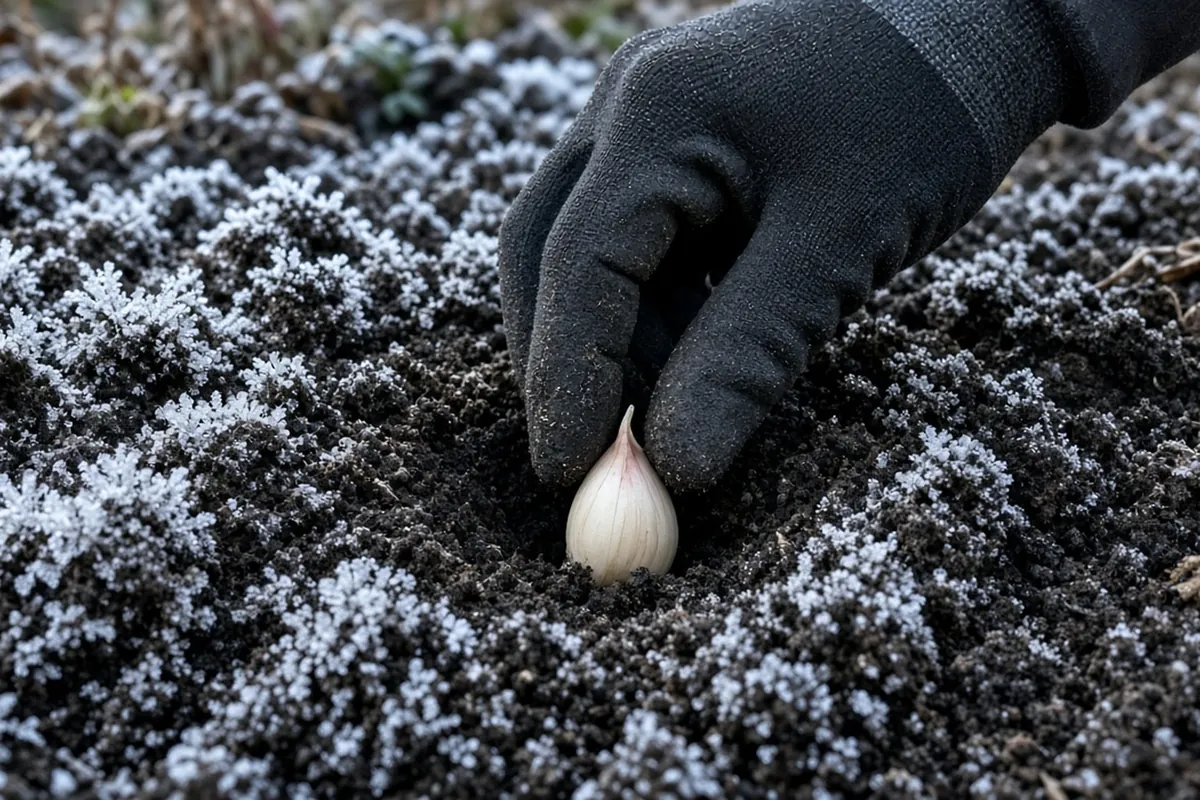
Print it, tick it off
My cold-zone garlic planting week
Fill this in from the frost lookup in September, then wait for the frost.
- My station and its typical first fall frost
- Planting week: frost date plus one to two weeks
- Date of this year's actual first frost
- Bed cleared and loosened before the frost
- Clove count and heads from the calculator
- Straw or shredded leaves ready by the bed
- Date planted and date mulched
What people learn the second year
Tips and tricks
- Get the bed ready before the frost. Clear and loosen the bed in September. When the frost comes, planting is a single afternoon.
- Write down the real frost night. Note the first night that frosts your yard. Next year you'll know how your spot compares with the station.
- Have the straw on hand early. Buy it when you buy the seed garlic, so it's next to the bed on planting day.
- Don't jump the gun on a warm September. The cold-zone pages want the shoots to stay below the soil until spring, so a warm spell is no reason to plant early.
- Read the earliest station in a low spot. If the garden sits in a dip or open country, use the earliest of the three stations the lookup shows.
Common questions
Questions
When should I plant garlic in zone 5?
Minnesota and Wisconsin Extension say one or two weeks after the first killing frost. At the St. Paul and Madison stations that works out to mid to late October.
Source: University of Minnesota Extension, Growing garlic in home gardens, checked October 8, 2026; University of Wisconsin Extension, Garlic (A3785), checked October 9, 2026; NOAA 1991-2020 U.S. Climate Normals, annual/seasonal, checked October 7, 2026.
When should I plant garlic in zone 4?
Use the same rule from an earlier frost date. At the Wausau, Wisconsin station the typical first frost is October 4, so planting falls around October 11 to 18.
Source: University of Wisconsin Extension, Garlic (A3785), checked October 9, 2026; NOAA 1991-2020 U.S. Climate Normals, annual/seasonal, checked October 7, 2026.
Should garlic be planted before or after the first frost in cold zones?
After. Minnesota and Wisconsin both say a week or two after the first killing frost, so roots grow before the hard freeze but shoots stay below the soil.
Source: University of Minnesota Extension, Growing garlic in home gardens, checked October 8, 2026; University of Wisconsin Extension, Garlic (A3785), checked October 9, 2026.
What if I plant garlic too early?
Maine's bulletin says early planting can let the top come up above the soil line, where it is prone to winter injury.
Source: University of Maine Extension, Bulletin #2063 Growing Hardneck Garlic in Your Maine Garden, checked October 9, 2026.
Is it too late to plant garlic once the ground has frozen?
The pages here don't cover planting into frozen ground. Iowa State gives early spring, late March to mid-April, as a second planting time.
Source: Iowa State Extension, When should I plant garlic?, checked October 8, 2026.
The arithmetic, done for you
Tools for this job
- ❄️ LookupFrost date lookup by zip codeFind the typical last spring and first fall frost for your zip code from NOAA 1991 to 2020 station normals, with the 1 in 10 year dates and a printable card.Open the tool
- 🧄 CalculatorGarlic and bulb planting calculatorHow many garlic cloves or spring bulbs fit a bed or a row, how many heads to buy, and how deep to plant them, from extension spacing figures.Open the tool
Keep reading
More guides
 🧰 Problem solverIt froze after the last frost date: how to read the oddsA last frost date is a coin flip, not a promise. How NOAA's 50% and 1 in 10 dates work, how to pick the right station, and which date to plan around.Read the guide
  🧰 Problem solverOne corner of the yard frosts first: find and fix a frost pocketFrost in the low corner but not by the house? Cold air drains downhill on still nights. How to find a frost pocket, open it up and plant around it.Read the guide
 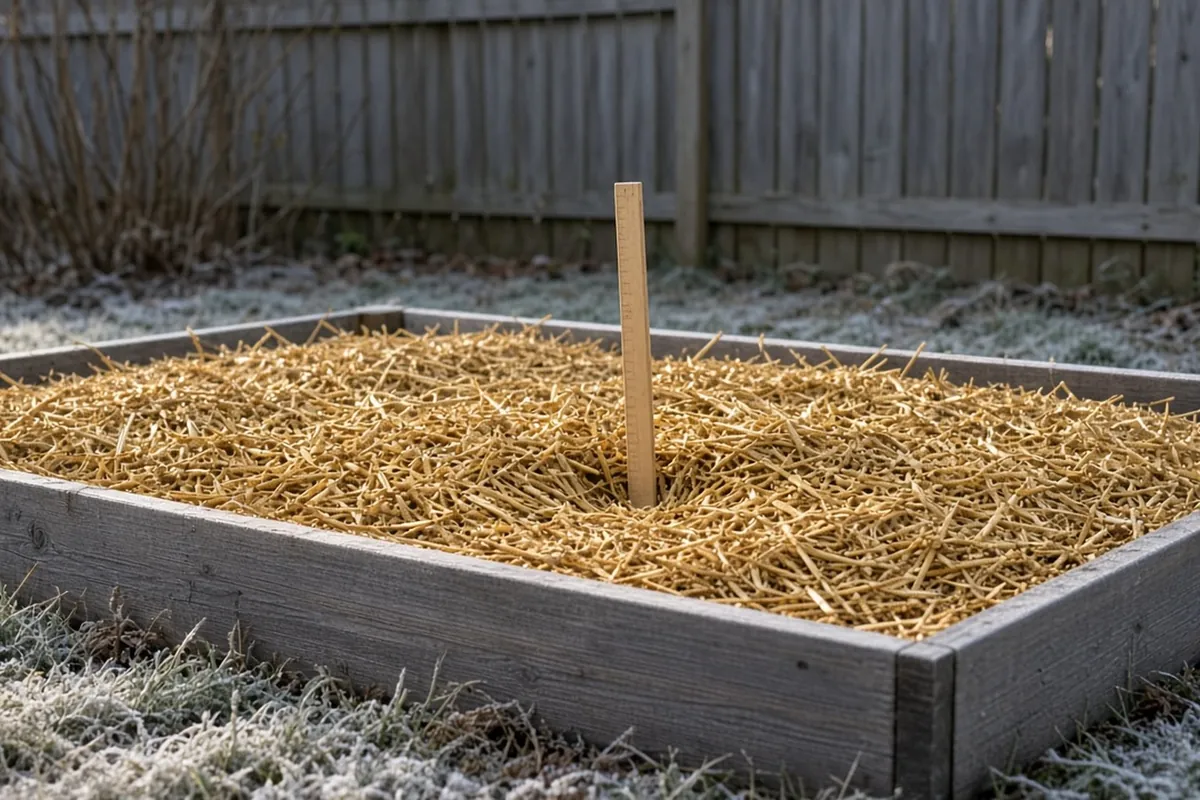 📘 Know-howHow deep to mulch garlic in cold zones, and when to pull the mulch backExtension pages put 3 to 4 inches of straw or leaves on fall garlic. See how much a bed takes, and when to pull it back, move it or leave it in spring.Read the guide
 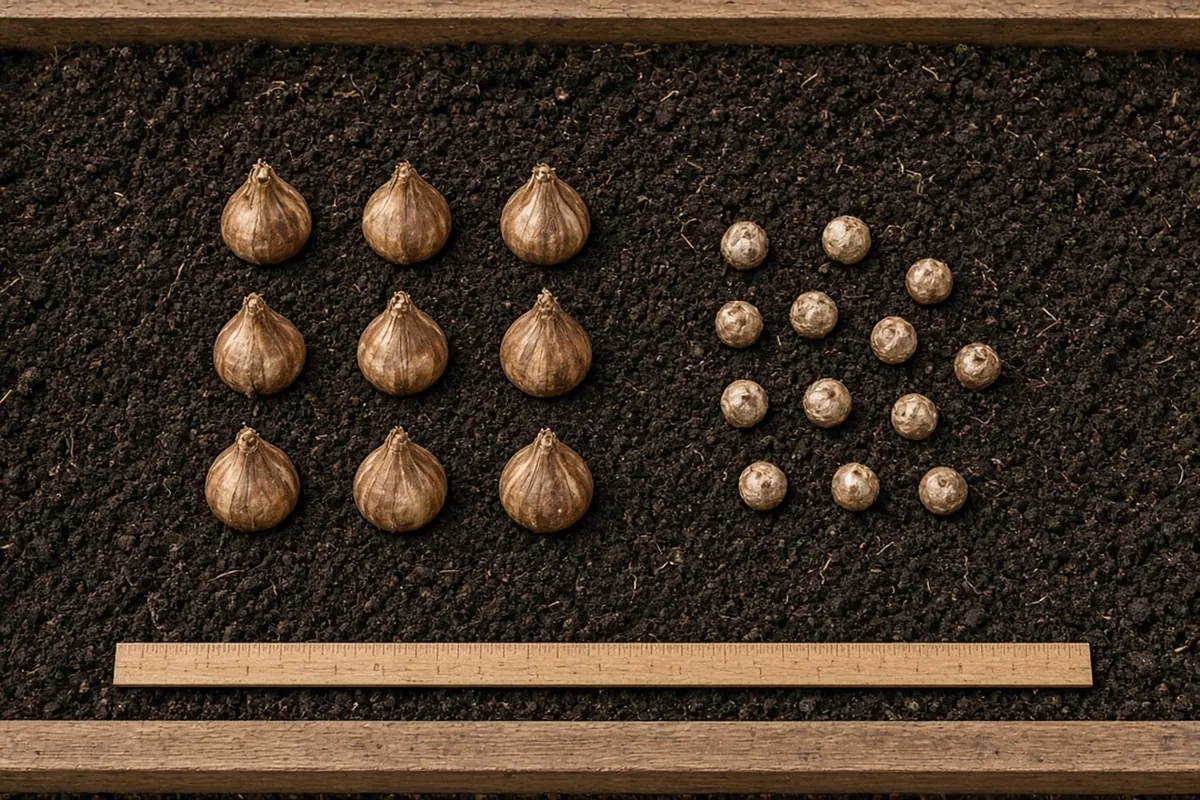 📘 Know-howHow many bulbs per square foot: tulips, daffodils and crocusTulips and daffodils at 6 inches apart come to 4 bulbs per square foot; crocus at 3 inches, 16. See the extension spacings and count a whole bed.Read the guide
Sources
- Growing garlic in home gardens, University of Minnesota Extension. Checked October 8, 2026.
- Garlic (Growing Garlic in Wisconsin, A3785), University of Wisconsin-Madison Division of Extension (Wisconsin Horticulture), published October 10, 2011. Checked October 9, 2026.
- Bulletin #2063, Growing Hardneck Garlic in Your Maine Garden, University of Maine Cooperative Extension, published August 6, 2025. Checked October 9, 2026.
- U.S. Climate Normals (1991-2020), annual/seasonal normals by station, NOAA National Centers for Environmental Information (NCEI). Checked October 7, 2026.
- 1991-2020 U.S. Climate Normals documentation: Annual/Seasonal Normals, NOAA National Centers for Environmental Information (NCEI). Checked October 7, 2026.
- 2023 USDA Plant Hardiness Zone GIS Datasets, PRISM Group, Oregon State University (for USDA). Checked October 6, 2026.
- When should I plant garlic?, Iowa State University Extension and Outreach, Yard and Garden, published July 24, 2024. Checked October 8, 2026.
Planning guide, not a guarantee. See every source on the site on the sources page. Spotted an error? Tell us.