🏺 ContainersFree toolPrintable record
Container soil calculator
Quick answer
Measure the inside of the pot: across the top, across the bottom and the height. Washington State University Extension says settled soil should sit about an inch below the rim, so fill depth is the height minus 1 inch. A pot 16 inches across the top, 12 across the bottom and 14 tall holds about 29.35 dry quarts. Four of them take 117.4 quarts, which is 8 bags of 16 qt.
Source: WSU Extension, Container Gardening tip sheet 6, checked October 7, 2026; Miracle-Gro Potting Mix product page, checked October 7, 2026.

Container soil calculator
Change any number and the answer updates as you type.
Potting mix needed for 4 pots 117.4 dry qt (4.57 cu ft, 129.3 liters)
| Buying by | How many |
|---|---|
| 8 qt bag | 15 bags |
| 16 qt bag | 8 bags |
| 1 cu ft bag | 5 bags |
| 2 cu ft bag | 3 bags |
Bag quarts are dry quarts: 1 cu ft is about 25.7 of them. That's 34.15 US gallons, though nursery-pot gallons are trade sizes, not exact measures.
- Each pot holds
- 29.4 dry qt (32.3 L)
- Mix depth in each pot
- 13 in (33 cm)
No garden math needed
How to use this, in plain words
Measure inside the pot: straight across the top, across the bottom, and the height. Run the tape across the middle of the rim, not near the edge.
Leave a gap at the top. WSU Extension says settled soil should sit about an inch below the rim so water can soak in; the tool starts at 1 inch.
Pick round or square, then type the sizes and how many pots of that size you have. Work out each pot size on its own and add the bag counts.
Read the bag count for 8 qt, 16 qt, 1 cu ft or 2 cu ft, or type the quarts printed on your own bag.
Source: WSU Extension, Container Gardening tip sheet 6, checked October 7, 2026; Miracle-Gro Potting Mix product page, checked October 7, 2026.
What the store won't tell you
Before you start
- The quarts on a potting mix bag are dry quarts, slightly bigger than the quarts on a milk carton. The tool counts in dry quarts, so its numbers match the bag.
- Measure inside the rim, not outside. A thick clay pot is noticeably smaller inside than out.
- Count the pots you'll repot this season as well as the empty ones, so you buy once.
- A pot that stays outside over winter needs plants hardy to two zones colder than your yard, Illinois Extension says. Check that before you fill a big pot and plant it.
Source: Illinois Extension, overwintering potted plants, checked October 6, 2026.
Go deeper: Bury it, group it or garage it: a winter plan for every pot · The two-zones-colder rule for plants that winter in pots · Quarts, liters and cubic feet on a soil bag: turning any label into cubic feet
The formula, in words
How it works
- Mix depth: pot height minus the gap below the rim. WSU Extension says about 1 inch, so the tool starts there.
- Round pot with sloping sides, all in inches: π × depth ÷ 12 × (bottom² + bottom × width at the fill line + width at the fill line²). With straight sides it is π × radius² × depth.
- Square pot, planter or window box: length × width × depth.
- Cubic feet: cubic inches ÷ 1,728. Dry quarts, the unit bagged potting mix is sold in: cubic inches ÷ 67.2.
- Bags: the total ÷ the bag size, rounded up. The table shows the 8 qt, 16 qt, 1 cu ft and 2 cu ft sizes listed on Miracle-Gro's product page, and you can add your own.
Source: WSU Extension, Container Gardening tip sheet 6, checked October 7, 2026; Miracle-Gro Potting Mix product page, checked October 7, 2026.
Printable sheet
What to record
Pots get moved, replanted and stored for winter, so a list saves measuring them again next spring. The printable pot list has one row per pot:
- Pot and where it sits
- Size: top, bottom and height
- Mix per pot, in quarts
- What's planted
- Date filled or repotted
- Winter plan: group, bury, garage or indoors
Checked by hand
Worked example
Four round patio pots, each 16 inches across the top, 12 inches across the bottom and 14 inches tall, filled to 1 inch below the rim.
- Mix depth: 14 in tall − 1 in gap below the rim = 13 in.
- Width at the fill line: 12 + (16 − 12) × 13 ÷ 14 = 15.71 in. One pot: π × 13 ÷ 12 × (12² + 12 × 15.71 + 15.71²) = 1972.3 cu in.
- All 4: 1972.3 × 4 = 7889 cu in.
- In bag units: 7889 ÷ 1,728 = 4.57 cu ft, or 7889 ÷ 67.2 = 117.4 dry quarts.
- Bags: 15 bags of 8 qt, 8 bags of 16 qt, 5 bags of 1 cu ft, 3 bags of 2 cu ft.
Why it may not match the bag or the store
If the answer surprises you
❓
The pot's gallon label doesn't match
Nursery pots and grow bags are sold by trade size, and what they really hold can be different. Go by your tape measure.
❓
A part bag left over
Bags only come whole, so the tool rounds up. The four example pots need 117.4 dry quarts, and 8 bags of 16 qt hold 128, so 10.6 quarts are left over for topping up.
❓
The soil sank after watering
Fresh mix settles once it's wet. WSU Extension's inch below the rim is for settled soil, so keep the extra mix to top up after the first watering.
Source: WSU Extension, Container Gardening tip sheet 6, checked October 7, 2026.
Other cases
Variants
🟫
Window boxes and long planters
Pick the square option and enter the inside length, width and height. Two window boxes 30 by 8 inches and 8 inches tall, filled to 1 inch below the rim, hold 50 dry quarts together. That's 4 bags of 16 qt.
Source: WSU Extension, Container Gardening tip sheet 6, checked October 7, 2026; Miracle-Gro Potting Mix product page, checked October 7, 2026.
⭕
Square pots that taper
The tool treats square pots as straight-sided. If yours narrows toward the base, measure the width halfway down and enter it as both length and width, and the answer comes out close.
🔁
Pots that stay outside all winter
Illinois Extension notes that the small amount of soil in a pot gets much colder than soil in the ground, and suggests plants hardy to two zones colder than where the pot sits. The guide gives that rule for potted plants in general, not by pot size.
Source: Illinois Extension, overwintering potted plants, checked October 6, 2026.
📏
Grow bags sold by the gallon
Grow bags and nursery pots carry gallon labels that may not match what they really hold. Fill the bag, measure across and down, and enter it as a round pot with straight sides.
Where each figure comes from
Numbers this tool uses
- About 1 in, once the soil settlesGap below the rim (WSU Extension)WSU Extension, Container Gardening tip sheet 6, October 7, 2026
- 8 to 10 in deep dry out faster than deeper onesShallow containers (WSU Extension)WSU Extension, Container Gardening tip sheet 6, October 7, 2026
- 8, 16, 25 and 50 qt; 1 and 2 cu ftPotting mix bag sizes (Miracle-Gro product page)Miracle-Gro Potting Mix product page, October 7, 2026
- Hardy to two zones colder than your zonePlants for pots left outdoors in winter (Illinois Extension)Illinois Extension, overwintering potted plants, October 6, 2026
Limitations
- Planning estimate, not a guarantee; check the quarts or cubic feet printed on your bag before you buy.
- Fresh potting mix settles after the first few waterings. The result is the volume up to the fill line, with nothing added for settling.
- The tool treats round pots as sloping evenly from top to bottom. A pot with a bulging middle or a thick rolled rim holds a little more or less.
What people learn the second year
Tips and tricks
- Fill big pots where they will stay. A large pot full of wet mix is hard to move. Set it in its final spot first, then fill it.
- Measure across the rim with a straightedge. Lay a ruler or a board across the top and measure the inside width under it. A tape alone sags in the middle.
- Tally pots by size. Group the pots by size, run each size once and add the totals. You get one shopping list instead of a pot by pot count.
- Wet the mix before it goes in. Dry potting mix sheds water at first. Stir some water into it in a tub or wheelbarrow, then fill the pots.
- Photograph the bag. A picture of the bag front keeps the product name and the quarts for next year's repotting list.
Read before the store run
Guides that go deeper
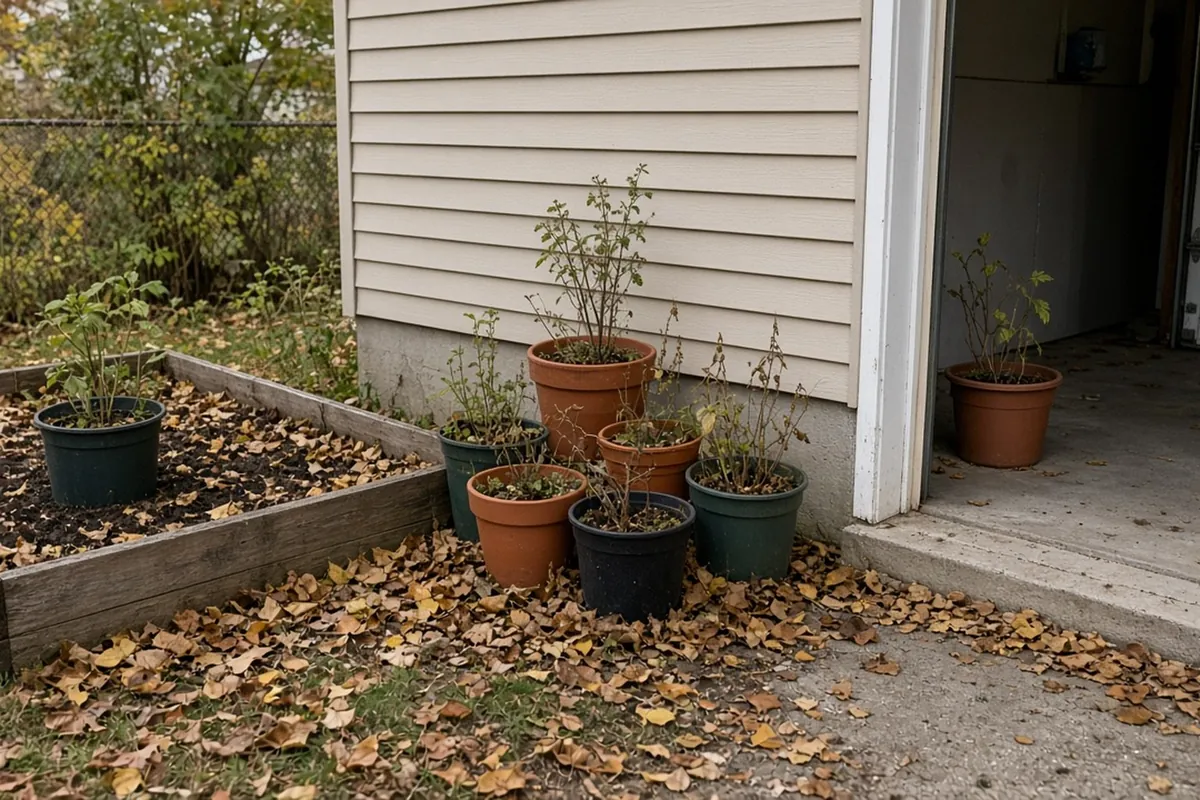 🧰 Problem solverBury it, group it or garage it: a winter plan for every potPotted perennials die in winter when their roots freeze. Three extension-backed winter plans, how to pick one per pot, and a checklist.Read the guide
 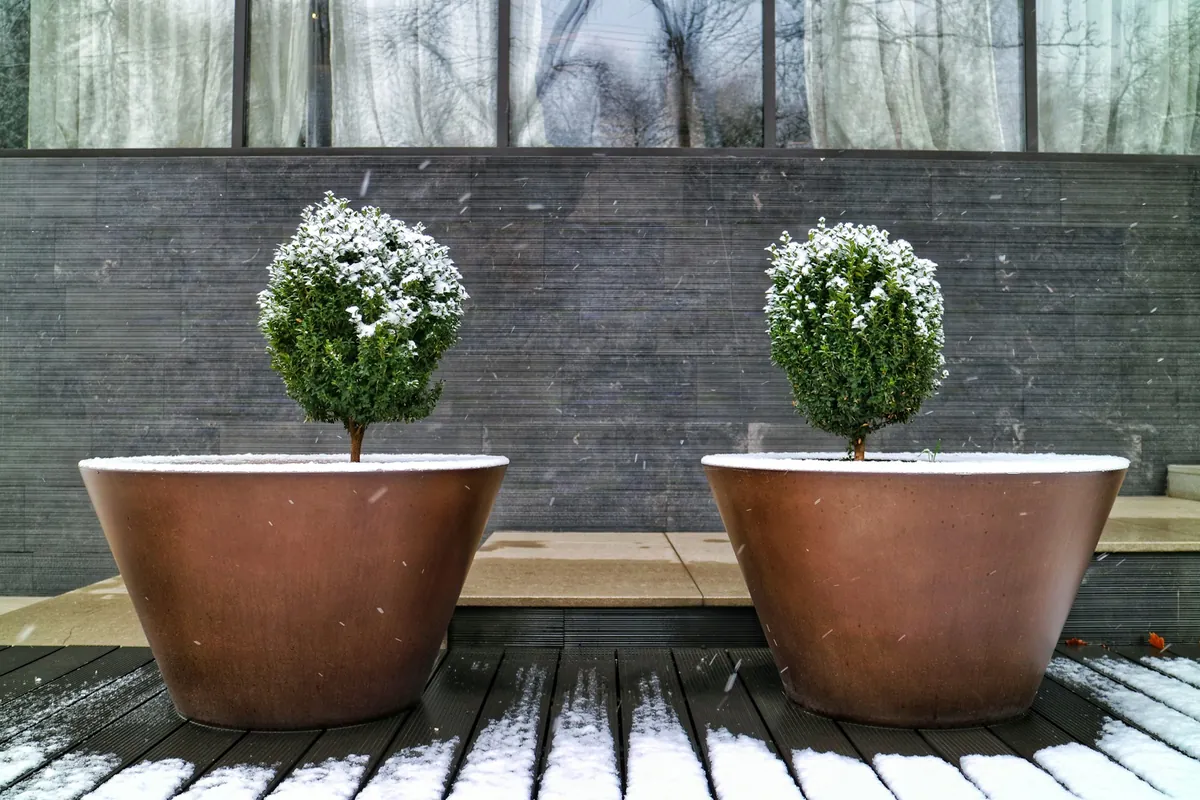 📘 Know-howThe two-zones-colder rule for plants that winter in potsWhy a perennial that winters outside in a pot needs a tag rated two zones colder than your yard, with a zone-by-zone table and a tag check.Read the guide
 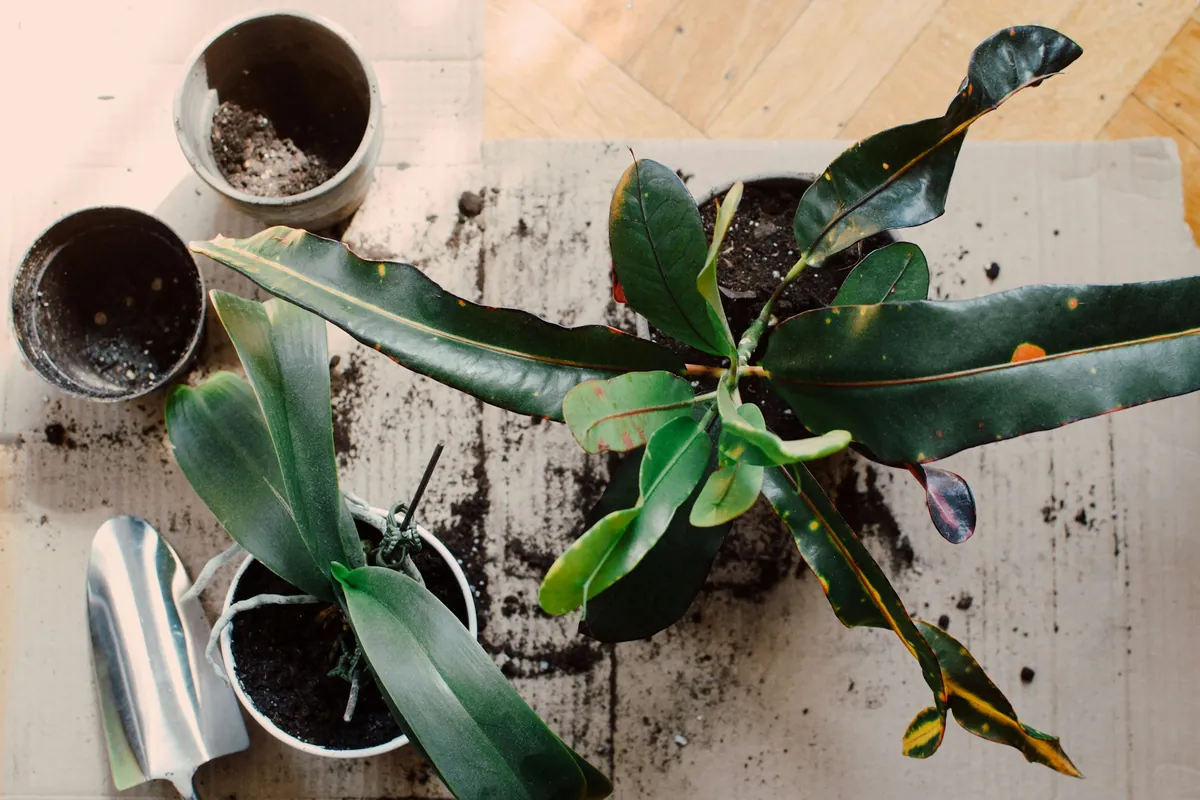 📘 Know-howQuarts, liters and cubic feet on a soil bag: turning any label into cubic feetPotting mix comes in quarts, mulch in cubic feet, some bags in liters. How to turn any bag label into cubic feet so you can count bags and compare prices.Read the guide
Common questions
Questions
How much potting soil do I need for a 12 inch pot?
A straight-sided pot 12 inches across and 10 inches tall, filled to 1 inch below the rim, holds about 15.15 dry quarts. That's 2 bags of 8 qt or 1 bag of 16 qt. Most pots narrow toward the base and hold less, so enter the bottom width too.
Source: WSU Extension, Container Gardening tip sheet 6, checked October 7, 2026; Miracle-Gro Potting Mix product page, checked October 7, 2026.
How many quarts are in a cubic foot of potting mix?
About 25.7. Bagged potting mix is sold in dry quarts of 67.2 cubic inches each, and a cubic foot is 1,728 cubic inches.
How full should I fill a pot with soil?
WSU Extension says settled soil should come to about an inch below the rim. The gap gives water room to soak in instead of running over the edge.
Source: WSU Extension, Container Gardening tip sheet 6, checked October 7, 2026.
Why does one big bag fill fewer pots than I expected?
Volume climbs fast as pots get wider. A pot 20 inches across the top, 16 across the bottom and 18 tall holds 63.82 dry quarts, more than the 51.4 quarts in a 2 cu ft bag.
Source: Miracle-Gro Potting Mix product page, checked October 7, 2026.
More for the same garden
Related tools
- 🪴 CalculatorRaised bed soil calculatorHow much soil fills a raised bed: cubic feet, cubic yards and a bag count for 1.5 or 2 cu ft bags, from the bed's length, width and depth.Open the tool
- 🌡️ LookupUSDA zone finder by zip codeFind your 2023 USDA plant hardiness zone by zip code, see its winter low band in °F and °C, and check a plant tag's zone range against it.Open the tool
- 🪱 CalculatorCompost and topsoil calculatorHow much compost or topsoil to buy for a garden bed or lawn: cubic feet, cubic yards and bag counts, plus the mix you get when you dig it in.Open the tool
- ❄️ LookupFrost date lookup by zip codeFind the typical last spring and first fall frost for your zip code from NOAA 1991 to 2020 station normals, with the 1 in 10 year dates and a printable card.Open the tool
- 🧺 SectionAll containers toolsPotting mix for pots, planters and window boxes in quarts, cubic feet and bags, with a printable pot list for balconies, patios and rentals.See the section
Sources
- Puget Sound Gardening Tip Sheet #6: Container Gardening, Washington State University Extension, King County Master Gardener Program. Checked October 7, 2026.
- Miracle-Gro Potting Mix, ScottsMiracle-Gro. Checked October 7, 2026.
- Overwintering potted plants, University of Illinois Extension. Checked October 6, 2026.
See every source on the site on the sources page. Spotted an error? Tell us.