🧰 Problem solverSoil and mulch4 min read
Do you need new mulch this year? Measure the old layer first
Quick answer
Measure before you buy. Push a ruler through the old mulch in three or four spots. If 2 to 3 inches are left, rake it loose and buy nothing; the Missouri Department of Conservation says not to add more when a good layer is already there. If less is left, buy only the difference up to 3 inches, which is Maryland Extension's limit. A 200 sq ft border with 1 inch left needs 17 bags of 2 cu ft, not 25.
Source: Missouri Dept. of Conservation, Mulch: Your Tree's Best Friend, checked October 10, 2026; Maryland Extension, Excess Mulch Problems, checked October 9, 2026.

Why it happens
Mulch every spring and the border slowly gets too deep
Extension pages don't agree on mulching every year. K-State Research and Extension says to reapply a tree ring's 2 to 4 inches every year. NC State's Henderson County office says you don't need new mulch every year, and that adding it yearly without taking any out leaves a deep pile around the plant.
Source: K-State Research and Extension, mulch rings for trees, checked October 10, 2026; NC State Extension Henderson County, excessive mulch, checked October 10, 2026.
Both can be right, because it comes down to how much of last year's layer is still there. Some mulch breaks down fast and some barely changes. The Missouri Department of Conservation's flyer says organic mulches break down at different rates and need replenishing now and then. It also says to check the depth first and not to add more if there's already enough. The bag's coverage line assumes bare ground, so it can't tell you that.
Source: Missouri Dept. of Conservation, Mulch: Your Tree's Best Friend, checked October 10, 2026.
- 3 inmost organic mulch should ever total (Maryland)Maryland Extension, Excess Mulch Problems, October 9, 2026
- 2 to 3 inaround plants over the root zone (NC State)NC State Extension Henderson County, excessive mulch, October 10, 2026
- 17 bagsfor 200 sq ft with 1 in left, not 25Arithmetic
- 0 bagswhen 3 in is still thereArithmetic
The fix
Measure, rake, then buy the difference
Read the old layer
Push a ruler or a marked stake down through the mulch until it hits soil. Check three or four spots, near the edge and in the middle, and average them.
Rake it loose
Old mulch packs into a crust. The Missouri flyer says to rake it to break up matted layers. Sometimes raking is all a tired border needs.
Source: Missouri Dept. of Conservation, Mulch: Your Tree's Best Friend, checked October 10, 2026.
Pull it back from stems
Maryland says to keep organic mulch 3 inches from the base of a trunk. Move it away from stems and trunks before you measure again.
Source: Maryland Extension, Excess Mulch Problems, checked October 9, 2026.
Work out what you're short
Target minus reading. With 3 inches as the target, 1 inch left means you buy 2 inches. With 2 inches left you buy 1, and with 3 left you buy nothing.
Turn inches into bags
Square feet times inches to add, divided by 12, gives cubic feet. A 10 x 20 ft border short 2 inches needs 200 x 2 / 12 = 33.3 cu ft, which is 17 bags of 2 cu ft.
| Old layer left | Inches to buy | Cu ft for 200 sq ft | Bags of 2 cu ft |
|---|---|---|---|
| 0 in | 3 in | 50 | 25 |
| 1 in | 2 in | 33.3 | 17 |
| 1.5 in | 1.5 in | 25 | 13 |
| 2 in | 1 in | 16.7 | 9 |
| 2.5 in | 0.5 in | 8.3 | 5 |
| 3 in or more | 0 | 0 | 0 |
Target 3 inches. Cubic feet = 200 x inches to buy / 12; bags rounded up.
Already too deep
Over 3 inches: take some out first
You don't have to haul it away. Maryland says mulch that's breaking down can be worked gently into the bed before the fresh layer goes on. Shovel the extra into a wheelbarrow and spread it thin on a bare patch, or put it in the compost pile. Then measure again and buy only what the ruler says.
Source: Maryland Extension, Excess Mulch Problems, checked October 9, 2026.

Print it, tick it off
Mulch top-up checklist
Take this, a ruler and a rake out before you order.
- Old layer measured in three or four spots and averaged
- Matted mulch raked loose
- Mulch pulled back from every stem and trunk
- Inches short of the target written down
- Any layer over the limit thinned first
- Border length and width in feet
- Cubic feet and bag count from the calculator
- Depth, amount added and date noted for next year
What people learn the second year
Tips and tricks
- Measure after a rain. Dry mulch fluffs up and can read deeper than it is. A reading after the bed has been wet and settled is closer to what's really there.
- Rake before you decide. Raking breaks the crust and shows bare spots. Some borders only need a few bags for the thin patches, not a full layer.
- Top up only the thin parts. Edges and paths can wear thin before the middle of a bed does. Measure those parts on their own and buy for them alone.
- Match the old color. Fresh dyed mulch over old faded mulch shows every gap. A thin, even top-up of the same kind blends in better than a thick patch.
- Keep a marked stake. Tape a stake at your target depth and leave it in the shed. Next year's check takes a minute.
Common questions
Questions
Do I need to remove old mulch before adding new?
Not if the total stays at 3 inches or less, which is Maryland Extension's limit. Rake the old layer loose and add only the difference. If it's already deeper, take some out first.
Source: Maryland Extension, Excess Mulch Problems, checked October 9, 2026.
Do you need to mulch every year?
Not always. NC State's Henderson County office says you don't need new mulch every year. Check the depth: if a good layer is still there, rake it and wait a year.
Source: NC State Extension Henderson County, excessive mulch, checked October 10, 2026.
How much mulch do I need to top up a bed?
Multiply the bed's square feet by the inches you're adding and divide by 12. A 200 sq ft border short 1 inch needs 16.7 cu ft, or 9 bags of 2 cu ft.
Why does the bag say it covers more than I need?
It doesn't know about the old layer. The coverage line assumes bare ground at one depth, so it overcounts when some mulch is already there.
What do I do with mulch that's too deep?
Maryland says breaking-down mulch can be worked gently into the bed. You can also spread the extra thin somewhere bare or add it to the compost pile.
Source: Maryland Extension, Excess Mulch Problems, checked October 9, 2026.
The arithmetic, done for you
Tools for this job
- 🍂 CalculatorMulch calculatorHow much mulch a bed takes in cubic feet, cubic yards and 1.5 or 2 cu ft bags, at the depth you pick, with the 2 to 3 inch band worked out too.Open the tool
- 🧺 SectionAll soil and mulch toolsRaised-bed soil, mulch, compost and topsoil calculators that give cubic feet, cubic yards and bag counts, using bag sizes printed by the makers.See the section
Keep reading
More guides
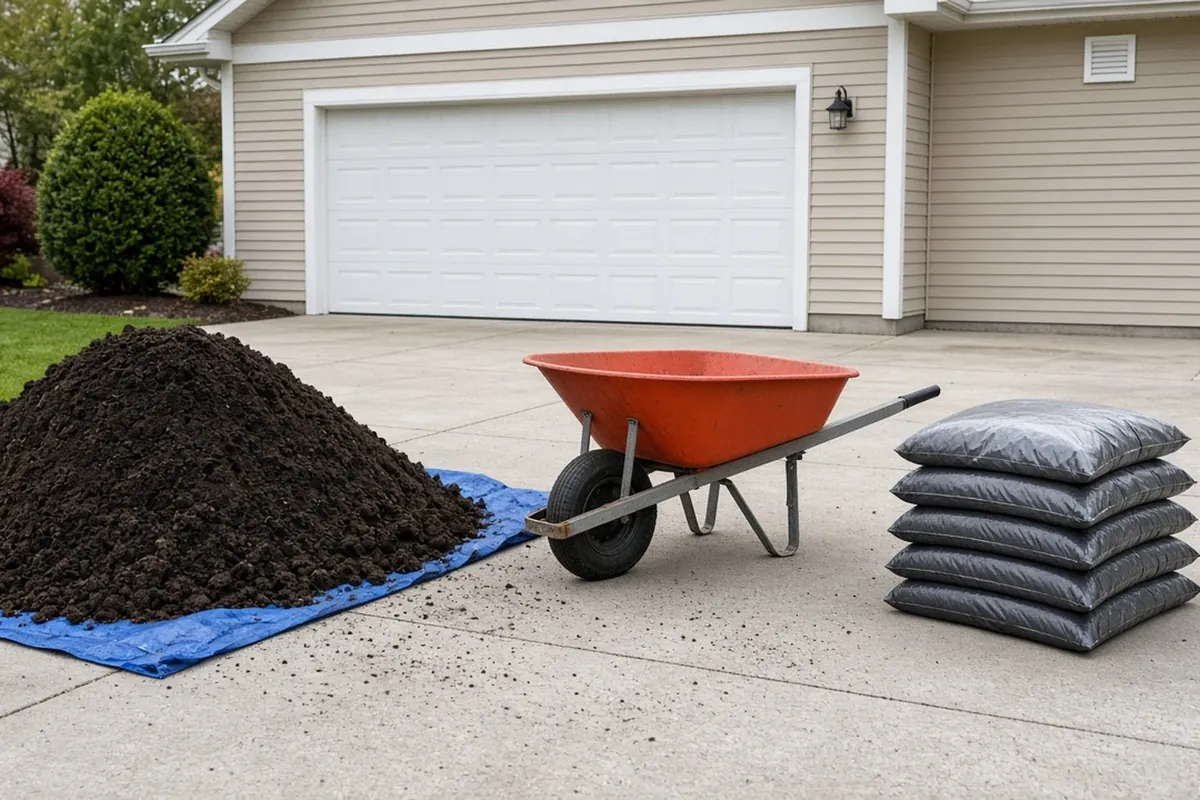 🧰 Problem solverBags or bulk: when a cubic yard delivery is cheaperHow to compare bagged soil, mulch or compost with a bulk cubic yard: price per cubic foot, the delivery fee, and the bag count where bulk wins.Read the guide
  ✅ ChecklistFall compost bin reset: empty the finished compost, then rebuild with leavesPull out the finished compost, spread it on your beds, then rebuild the bin 3 ft each way with fall leaves and greens, damp as a wrung-out sponge.Read the guide
 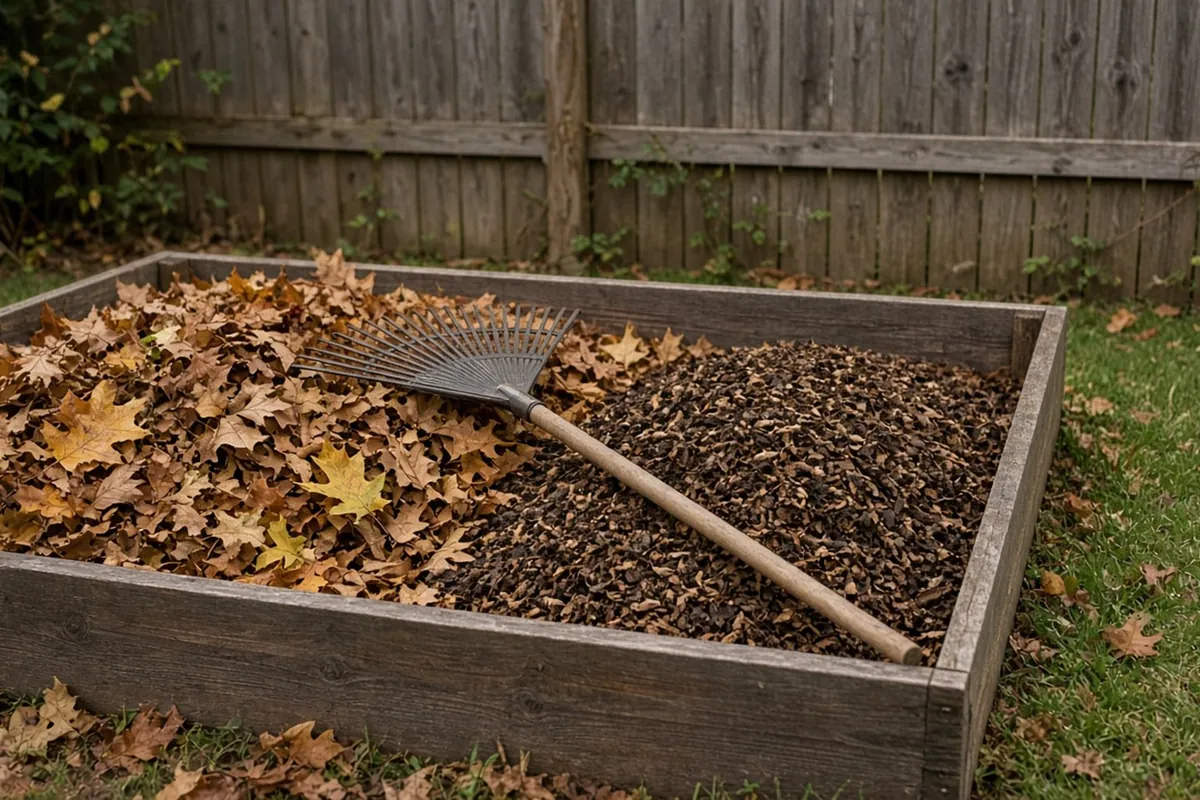 🧰 Problem solverWhat to do with fall leaves in the garden: shred them into mulchShred the leaves, then spread 2 to 3 inches on beds and 3 to 4 around shrubs. How to shred without a shredder, and how many bags a bed takes.Read the guide
  🧰 Problem solverHow to fill a tall raised bed without buying 2 yards of soilA 4 x 8 bed 24 inches tall holds 64 cu ft. Put logs, branches and leaves in the lower half and you buy 32 cu ft of soil instead. What goes in, what stays out.Read the guide
Sources
- Mulch: Your Tree's Best Friend (F00111), Missouri Department of Conservation (flyer hosted by UC Agriculture and Natural Resources), published January 1, 2010. Checked October 10, 2026.
- Excess Mulch Problems, University of Maryland Extension, published March 14, 2023. Checked October 9, 2026.
- Mulch rings help to promote healthy trees, Kansas State University Research and Extension, published August 8, 2025. Checked October 10, 2026.
- Plant Health Alert: Excessive Mulch, N.C. Cooperative Extension, Henderson County Center (NC State Extension), published August 7, 2025. Checked October 10, 2026.
Planning guide, not a guarantee. See every source on the site on the sources page. Spotted an error? Tell us.