🧭 Garden systemZones9 stepsFree working copy
Garlic planting in zones 8 to 10: plant in October, let winter chill it
Quick answer
In zones 8 to 10, garlic goes in during fall, ahead of the first frost. Georgia Extension gives late September through November and wants an October planting rooted by November. Near Atlanta the typical first frost is November 8. At Georgia's spacing, 6 inches apart in rows 12 inches apart, a 4 x 8 ft bed takes 64 cloves, or 8 to 11 heads of softneck garlic. Set them 1 to 3 inches deep, pointed side up, and add 2 to 3 inches of mulch once the shoots are up. The winter after planting supplies the cold.
Source: UGA Extension, Garlic Production for the Gardener (C 854), checked October 9, 2026; University of Kentucky Extension, October is garlic planting time, checked October 8, 2026; NOAA 1991-2020 U.S. Climate Normals, annual/seasonal, checked October 7, 2026.

Decide first
Should you plant garlic this fall?
Do it yourself
Plant it yourself
If you have a sunny bed you won't need until early summer, this is one October afternoon. Georgia's harvest runs from late May to mid-July, depending on the area.
Source: UGA Extension, Garlic Production for the Gardener (C 854), checked October 9, 2026.
Skip it
Skip it if the bed is needed in spring
Fall garlic holds the bed through spring. Don't count on planting it in spring instead: Georgia Extension says that leaves too short a season for good yields. If you need the bed for spring crops, put the garlic somewhere else.
Source: UGA Extension, Garlic Production for the Gardener (C 854), checked October 9, 2026.
Get help
Ask your county extension office
For varieties that do well in your county, or if the plants look wrong in spring, call your county Cooperative Extension office. This page covers dates, counts, mulch and the bed layout, not plant problems.
- Late Sep to NovGeorgia's planting windowUGA Extension, Garlic Production for the Gardener (C 854), October 9, 2026
- Nov 8typical first frost at the Atlanta airport stationNOAA 1991-2020 U.S. Climate Normals, annual/seasonal, October 7, 2026
- 1 to 3 indeep, pointed side up, 6 in apartUGA Extension, Garlic Production for the Gardener (C 854), October 9, 2026
- 6 to 8 wkbelow 40°F after planting, from the winterUGA Extension, Garlic Production for the Gardener (C 854), October 9, 2026
September to look up, one October afternoon to plant
The steps, in order
Look up your first fall frost
Type your zip code into the frost date lookup and write down the typical first fall frost and the 1 in 10 earlier date. For zip code 30303 in Atlanta, the Fulton County Airport station 7.8 miles away gives November 8 and October 27.
Have ready: Your zip code. Do it in September, while you order the seed garlic.
Source: NOAA 1991-2020 U.S. Climate Normals, annual/seasonal, checked October 7, 2026.
Put October on the calendar
Georgia's window runs from late September through November, and the page wants an October planting well rooted, with tops above the soil, by November. Planted in October, Atlanta cloves get 8 to 38 days before the typical frost. In warm zones you plant ahead of the frost and don't wait for it.
Have ready: The frost date from step 1 and a calendar.
Source: UGA Extension, Garlic Production for the Gardener (C 854), checked October 9, 2026; NOAA 1991-2020 U.S. Climate Normals, annual/seasonal, checked October 7, 2026.
Measure the bed and count the cloves
Measure inside the boards and type the size into the garlic calculator at 6 inches apart with rows 12 inches apart, the low end of Georgia's 12 to 14 inches. A 4 x 8 ft bed takes 4 rows of 16: 64 cloves.
Have ready: A tape measure.
Garlic and bulb planting calculator
Source: UGA Extension, Garlic Production for the Gardener (C 854), checked October 9, 2026.
Buy softneck heads
Georgia says softneck garlic suits the South and that hardneck types generally prefer cold winters. At Kentucky's six to eight cloves a head, 64 cloves is 8 to 11 heads. Keep them whole and out of the fridge until planting day.
Have ready: The clove count. If the seller lists cloves per head for the variety, use that number.
Source: UGA Extension, Garlic Production for the Gardener (C 854), checked October 9, 2026; University of Kentucky Extension, October is garlic planting time, checked October 8, 2026; San Diego County Master Gardeners, Garlic, checked October 9, 2026.
Loosen the bed
Before planting, Georgia asks for well-tilled, loose soil. Pull the summer crop, fork the bed over and rake it level the week before.
Have ready: A garden fork and a rake.
Source: UGA Extension, Garlic Production for the Gardener (C 854), checked October 9, 2026.
Split the heads on planting day
Georgia says not to divide the bulb until you're ready to plant, because early separation lowers yields. Plant the largest cloves, since Wisconsin says they generally grow the largest bulbs. Keep the small ones for the kitchen.
Have ready: A bowl for the planting cloves and another for the small ones.
Source: UGA Extension, Garlic Production for the Gardener (C 854), checked October 9, 2026; University of Wisconsin Extension, Garlic (A3785), checked October 9, 2026.
Plant 1 to 3 inches deep, 6 inches apart
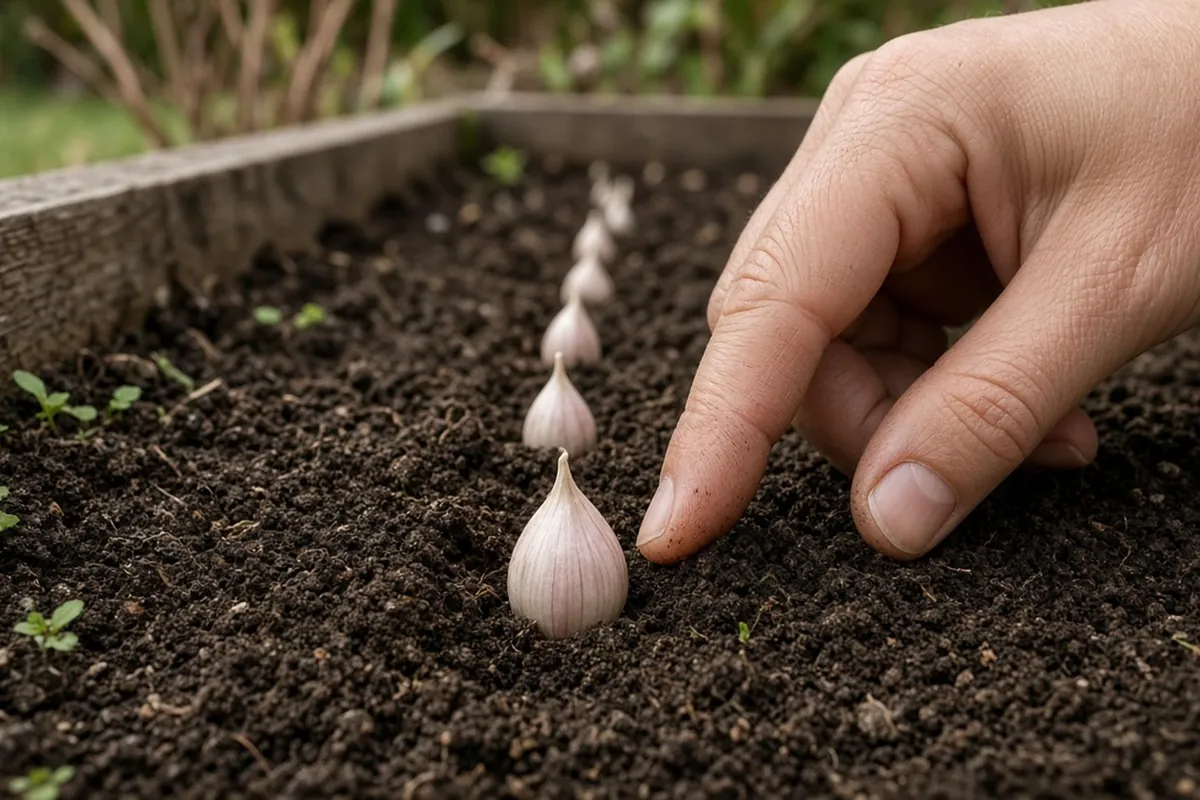
Set each unpeeled clove in its hole pointed side up, 1 to 3 inches deep, as Georgia says. Start the first row 6 inches in from the long board and the first clove 3 inches in from the end, so all 4 rows of 16 fit.
Have ready: A stick marked at 1, 3 and 6 inches.
Source: UGA Extension, Garlic Production for the Gardener (C 854), checked October 9, 2026.
Mulch once the shoots are up
Mulch goes on after the garlic has come up: 2 to 3 inches over the whole bed, kept 2 to 3 inches away from each stem, Georgia says. For a 4 x 8 ft bed that's 5.3 to 8 cubic feet.
Have ready: Straw or another mulch, bought when you plant.
Source: UGA Extension, Garlic Production for the Gardener (C 854), checked October 9, 2026.
Let winter chill it, then log the harvest
The cold comes in the bed: Georgia counts 6 to 8 weeks below 40°F after planting, so nothing goes in the fridge. Harvest runs from late May to mid-July, depending on the area, once a third to half of the leaves have died back. Write both dates in the log.
Have ready: The printed bed plan, kept with the seed box.
Source: UGA Extension, Garlic Production for the Gardener (C 854), checked October 9, 2026.
Free, one page, black and white
Print the working copy
Garlic bed plan: the steps above as a checklist with a date box for each, on one US Letter page.
If a step gets skipped
What goes wrong
⚠️
Waiting for the first frost
That's the cold-zone rule. In Georgia the window opens in late September, and by Atlanta's typical first frost on November 8 only about three weeks of it are left. Georgia wants the cloves rooted by November, so plant ahead of the frost.
Source: UGA Extension, Garlic Production for the Gardener (C 854), checked October 9, 2026; NOAA 1991-2020 U.S. Climate Normals, annual/seasonal, checked October 7, 2026.
⚠️
Splitting the heads early
Georgia says early separation of the cloves decreases yields. Break the heads apart on the day you plant.
Source: UGA Extension, Garlic Production for the Gardener (C 854), checked October 9, 2026.
⚠️
Mulching at planting time, or up against the stems
Georgia's page puts mulch on after the garlic has emerged and keeps it 2 to 3 inches off each stem. Stack the straw by the bed and wait for the shoots.
Source: UGA Extension, Garlic Production for the Gardener (C 854), checked October 9, 2026.
⚠️
Buying hardneck from a cold-climate catalog
Georgia says hardneck garlic may grow there but generally prefers cold winters, while softneck suits the South. Check the type before you order.
Source: UGA Extension, Garlic Production for the Gardener (C 854), checked October 9, 2026.
⚠️
Keeping the seed garlic in the fridge
San Diego County's master gardeners say cold makes garlic sprout, which is why bulbs shouldn't be stored in a refrigerator. Keep the heads somewhere cool and dry until planting day.
Source: San Diego County Master Gardeners, Garlic, checked October 9, 2026.
When the steps change
Variants
🪴
Zone 9 in south Georgia and Texas
Georgia's window covers the whole state, including zone 9a Tifton, where the typical first frost is November 19. Texas A&M AgriLife gives no month and times planting by soil temperature instead: below 85°F at 2 inches deep. At the Austin station the typical first frost is November 17.
Source: UGA Extension, Garlic Production for the Gardener (C 854), checked October 9, 2026; Texas A&M AgriLife Extension, Garlic crop sheet, checked October 9, 2026; NOAA 1991-2020 U.S. Climate Normals, annual/seasonal, checked October 7, 2026; PRISM 2023 USDA hardiness zone GIS datasets and zip-code listing, checked October 6, 2026.
🏙️
Florida
UF/IFAS says late fall through early winter and names Artichoke and Creole as softneck varieties for Florida. At the Gainesville airport station the typical first frost is December 2. The UF page gives no depth or spacing, so this plan uses Georgia's.
Source: UF/IFAS Gardening Solutions, Garlic, checked October 9, 2026; NOAA 1991-2020 U.S. Climate Normals, annual/seasonal, checked October 7, 2026.
❄️
Arizona, zone 8
Arizona's Yavapai County office says September or October, cloves 3 to 4 inches deep and 6 inches apart in rows 12 to 18 inches apart, then 4 to 6 weeks below 40°F after planting. At the Sedona station the typical first frost is November 17.
Source: University of Arizona Extension, Backyard Gardener #160: Garlic, checked October 9, 2026; NOAA 1991-2020 U.S. Climate Normals, annual/seasonal, checked October 7, 2026.
☀️
Zone 10 and the frost-free coast
San Diego County's master gardeners plant in October to November, coastal and inland, with coastal cloves under about 1/2 inch of soil and 4 to 6 inches apart. El Cajon, zone 10a, has a typical first frost of December 21, and the Lindbergh Field station, zone 11a, has none. No extension page we checked gives a fridge chilling time, so our pre-chilling guide treats it as a side-by-side test.
Source: San Diego County Master Gardeners, Garlic, checked October 9, 2026; NOAA 1991-2020 U.S. Climate Normals, annual/seasonal, checked October 7, 2026; PRISM 2023 USDA hardiness zone GIS datasets and zip-code listing, checked October 6, 2026.
What people learn the second year
Tips and tricks
- Order early, keep the heads whole. Order seed garlic in late summer so it's there when October starts. Georgia says not to split the heads until planting day. (UGA Extension, Garlic Production for the Gardener (C 854))
- Mark the stick. Cut a stick to 6 inches and mark 1 and 3 inches on it. It sets the spacing and both ends of the depth range.
- Count the cloves in one head first. In a New Mexico trial, mean cloves per bulb ran from 5.5 to 15.9 across varieties. Break one head before you order the rest, and redo the head count if yours isn't near Kentucky's six to eight. (NMSU Research Report 717, Varietal Evaluation of Garlic in New Mexico; University of Kentucky Extension, October is garlic planting time)
- The shoots tell you when to mulch. Write down the day the first green tips show. That's the week the mulch goes on, by Georgia's timing. (UGA Extension, Garlic Production for the Gardener (C 854))
- Label the rows. Under the mulch every row looks the same. Put a tall tag at the start of each variety.
The one we checked the steps against
Primary source
Garlic Production for the Gardener (Circular 854), University of Georgia Cooperative Extension, published August 17, 2021. Checked October 9, 2026.
University of Georgia Extension writes for Georgia gardeners. Its garlic circular gives the late September through November window, the October planting rooted by November, the 6 to 8 weeks of cold after planting, the 1 to 3 inch depth with 6 inch spacing, mulch after the shoots are up, and the harvest sign.
The arithmetic and the background reading
Tools and guides in this system
- 🧄 CalculatorGarlic and bulb planting calculatorHow many garlic cloves or spring bulbs fit a bed or a row, how many heads to buy, and how deep to plant them, from extension spacing figures.Open the tool
- ❄️ LookupFrost date lookup by zip codeFind the typical last spring and first fall frost for your zip code from NOAA 1991 to 2020 station normals, with the 1 in 10 year dates and a printable card.Open the tool
- 🍂 CalculatorMulch calculatorHow much mulch a bed takes in cubic feet, cubic yards and 1.5 or 2 cu ft bags, at the depth you pick, with the 2 to 3 inch band worked out too.Open the tool
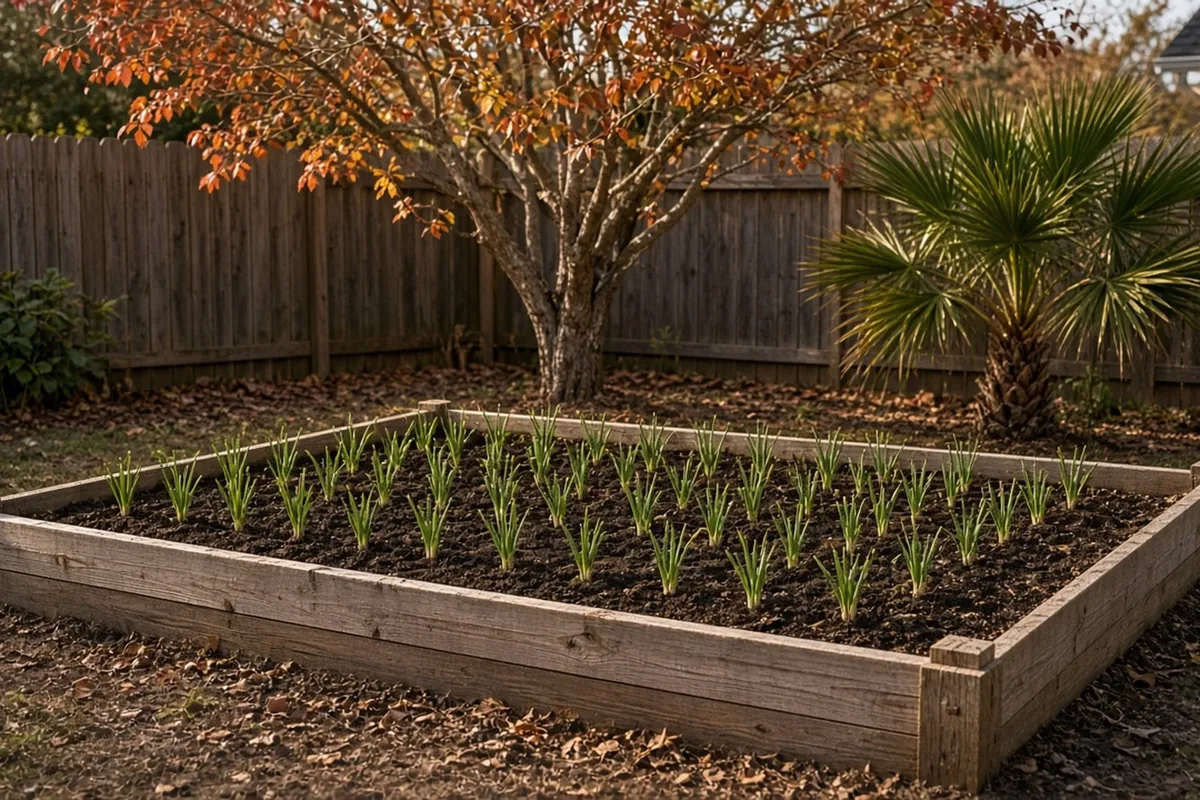 🧰 Problem solverWhen to plant garlic in zones 8 to 10: fall, ahead of the first frostGeorgia, Arizona, Florida and San Diego extension pages put warm-zone garlic in from late September into winter. See how that fits your first frost.Read the guide
 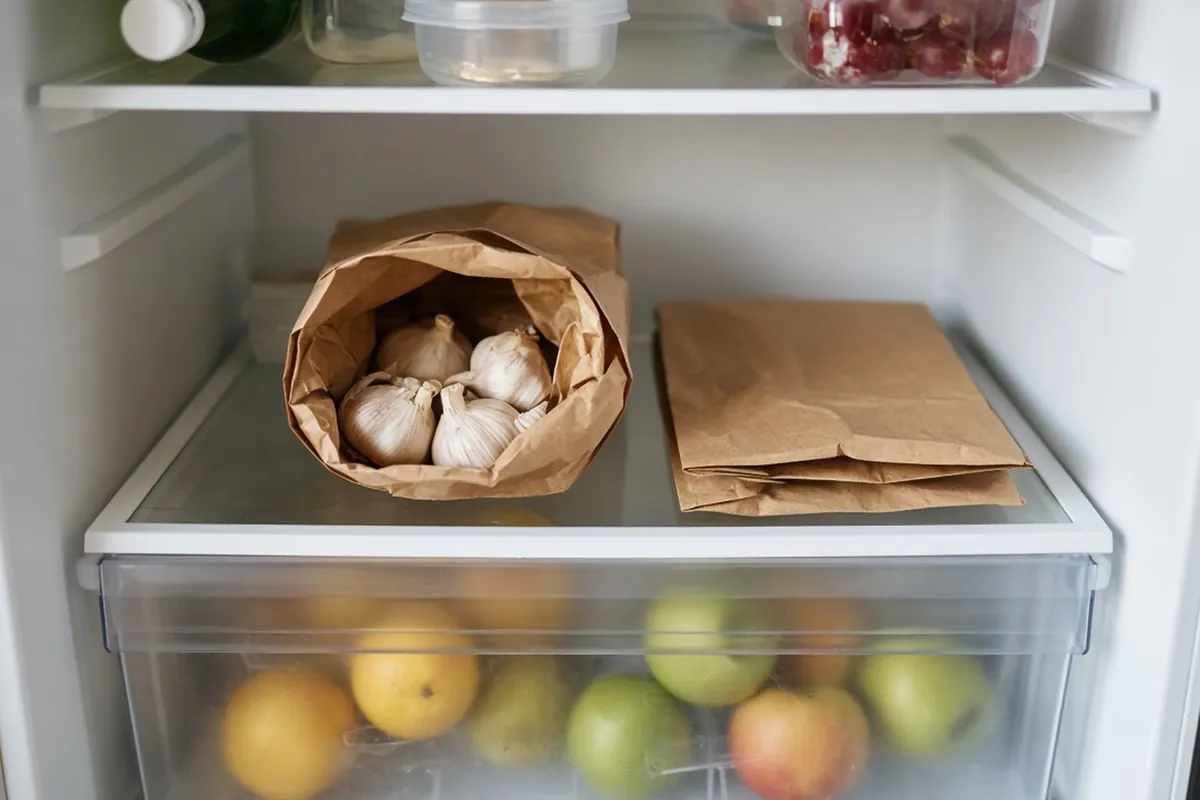 📘 Know-howDo garlic cloves need pre-chilling in zones 8 to 10?Garlic needs 6 to 8 weeks below 40°F before it bulbs. Here is what Texas, Georgia and Arizona extension pages say, and when a fridge chill is worth a test.Read the guide
Common questions
Questions
When should I plant garlic in zone 8?
Georgia Extension says late September through November, with October plantings rooted by November, and Arizona's Yavapai County office says September or October. Near Atlanta, zone 8a, the typical first frost is November 8, so October planting comes ahead of it.
Source: UGA Extension, Garlic Production for the Gardener (C 854), checked October 9, 2026; University of Arizona Extension, Backyard Gardener #160: Garlic, checked October 9, 2026; NOAA 1991-2020 U.S. Climate Normals, annual/seasonal, checked October 7, 2026; PRISM 2023 USDA hardiness zone GIS datasets and zip-code listing, checked October 6, 2026.
How deep do I plant garlic in the South?
Georgia says 1 to 3 inches deep and 6 inches apart, pointed side up, in rows 12 to 14 inches apart. Arizona's Yavapai County office goes 3 to 4 inches deep, and near the San Diego coast cloves sit under about 1/2 inch of soil.
Source: UGA Extension, Garlic Production for the Gardener (C 854), checked October 9, 2026; University of Arizona Extension, Backyard Gardener #160: Garlic, checked October 9, 2026; San Diego County Master Gardeners, Garlic, checked October 9, 2026.
Do I need to chill garlic before planting in zone 9?
Georgia and Arizona extension pages count the cold after planting, in the bed, so across most of zone 9 the winter does it. No extension page we checked gives a fridge time. Our pre-chilling guide covers the frost-free spots.
Source: UGA Extension, Garlic Production for the Gardener (C 854), checked October 9, 2026; University of Arizona Extension, Backyard Gardener #160: Garlic, checked October 9, 2026.
When do I mulch garlic in a warm zone?
After the shoots are up, Georgia says: 2 to 3 inches over the whole bed, kept 2 to 3 inches away from each stem. A 4 x 8 ft bed takes 5.3 to 8 cubic feet.
Source: UGA Extension, Garlic Production for the Gardener (C 854), checked October 9, 2026.
When is garlic ready to harvest in Georgia?
From late May to mid-July, depending on the area, Georgia Extension says. Harvest once a third to half of the leaves have died back.
Source: UGA Extension, Garlic Production for the Gardener (C 854), checked October 9, 2026.
The next job on the shelf
More garden systems
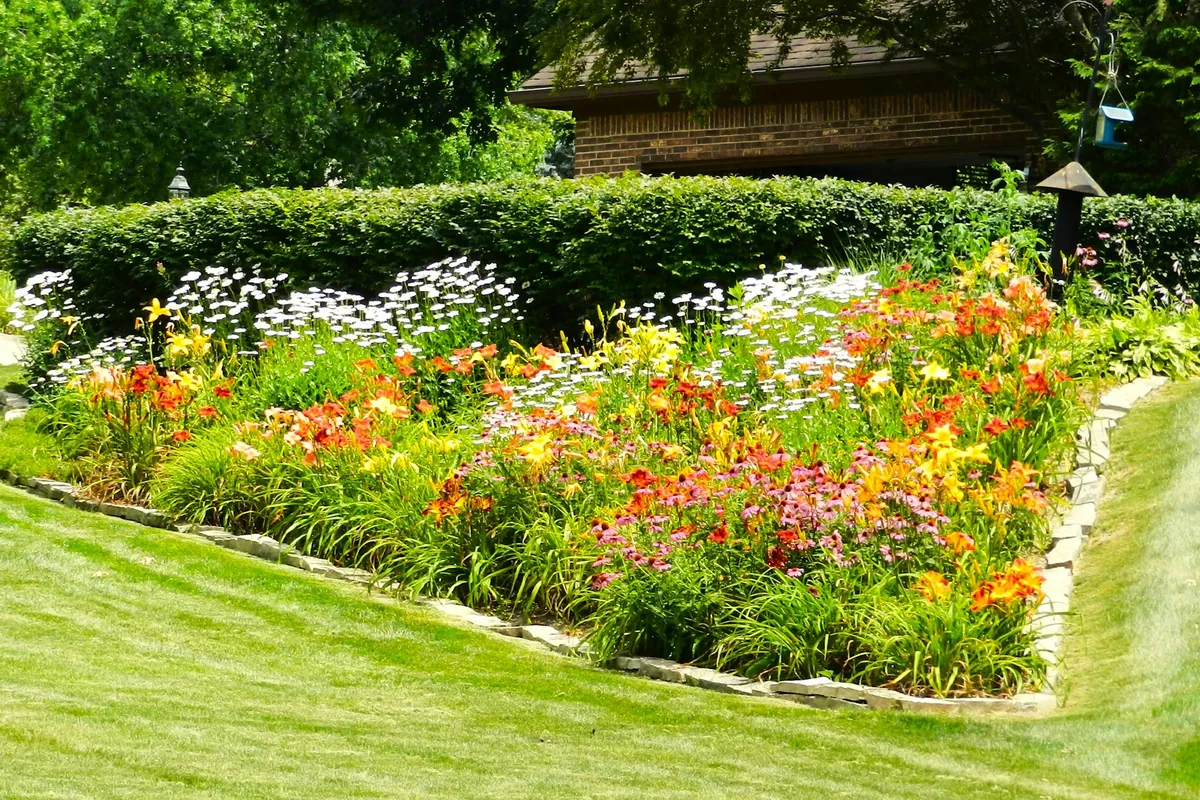 7 steps🧭 SystemRefresh border mulch: measure each bed, then buy only the gapMeasure the old layer in every bed before you order. One example yard needs 23 bags of 2 cu ft, not 45. The steps, the 3 inch limit and a free mulch record.Open the system
  7 steps🧭 SystemTurn fall leaves into bed cover and mulch, and keep a tally of the bagsWhat to do with fall leaves: mow a thin layer into the lawn, shred the rest and spread 2 to 3 inches on beds. Free leaf haul tally to print.Open the system
  6 steps🧭 SystemFall raised bed reset: clear, top up and cover for winterPut a raised bed to bed in fall: clear finished plants, measure how far the soil sank, top it up with compost and cover it with leaves. Free checklist.Open the system
Sources
- Garlic Production for the Gardener (Circular 854), University of Georgia Cooperative Extension, published August 17, 2021. Checked October 9, 2026.
- October is garlic planting time, University of Kentucky, Martin-Gatton College of Agriculture, Food and Environment (Cooperative Extension), published October 13, 2022. Checked October 8, 2026.
- U.S. Climate Normals (1991-2020), annual/seasonal normals by station, NOAA National Centers for Environmental Information (NCEI). Checked October 7, 2026.
- Garlic, Master Gardener Association of San Diego County (supports the UC Master Gardener Program of San Diego County). Checked October 9, 2026.
- Garlic (Growing Garlic in Wisconsin, A3785), University of Wisconsin-Madison Division of Extension (Wisconsin Horticulture), published October 10, 2011. Checked October 9, 2026.
- Garlic, Texas A&M AgriLife Extension Service, Department of Horticulture. Checked October 9, 2026.
- 2023 USDA Plant Hardiness Zone GIS Datasets, PRISM Group, Oregon State University (for USDA). Checked October 6, 2026.
- Garlic, University of Florida IFAS Extension, Gardening Solutions. Checked October 9, 2026.
- Backyard Gardener #160: Garlic, University of Arizona Cooperative Extension, Yavapai County. Checked October 9, 2026.
- Varietal Evaluation of Garlic in New Mexico (Research Report 717), New Mexico State University, Agricultural Experiment Station. Checked October 8, 2026.
Planning guide, not a guarantee. See every source on the site on the sources page. Spotted an error? Tell us.