🧭 Garden systemBeds8 stepsFree working copy
End-of-season review: turn this year's harvest into next year's plan
Quick answer
Total each crop's pounds from the harvest log and divide by its feet of row. Compare that with Mississippi State Extension's average for the same row: 11 lb of bush beans from 16 ft is 115% of the 9.6 lb average. Grade each crop, decide whether to grow it again, size next year's row from the pounds you want, and move each plant family to a different bed.
Source: N.C. Cooperative Extension Forsyth County, Garden Journal template, checked October 22, 2026; Mississippi State Extension, vegetable planting guide, checked October 21, 2026; Iowa State Extension, Crop Rotation in the Vegetable Garden, checked October 22, 2026.

Decide first
Review the season yourself, skip it, or get help?
Do it yourself
Do the review yourself
Do it if you grew vegetables in beds or rows and wrote down at least some of the picks. You need the harvest log, a sketch of the beds and about an hour on a fall evening.
Skip it
Skip it
If you grew a pot or two of herbs, or nothing you'd weigh, there's nothing to review. Write on each seed packet whether you'd grow that crop again and put the packets away.
Get help
Get help with a crop that failed
This review covers weights, rows and beds. When a crop did badly and you want to know why, take your notes to your county extension office or its Master Gardener volunteers. This page doesn't diagnose plant problems.
- 9.6 lbbush snap bean average for 16 ft of rowMississippi State Extension, vegetable planting guide, October 21, 2026
- 115%11 lb from those 16 ft, against the averageMississippi State Extension, vegetable planting guide, October 21, 2026
- 3 to 4 yrbefore a plant family returns to the same bedIowa State Extension, Crop Rotation in the Vegetable Garden, October 22, 2026
- 16 ozin a pound, for a scale that reads ouncesNIST Handbook 44 (2026), Appendix C, General Tables of Units of Measurement, October 22, 2026
One fall evening with the harvest log
The steps, in order
Put the season's records in one place
Find the harvest log, the bed sketch and the empty seed packets. N.C. Extension's garden journal keeps them together: a map of the beds, a summary of planting and harvest dates, and a harvest log in pounds.
Have ready: The harvest log, a bed sketch, the seed packets and a pen.
Source: N.C. Cooperative Extension Forsyth County, Garden Journal template, checked October 22, 2026.
Add up each crop's pounds
Add each crop's row on the log to get its total. If you weighed in ounces, divide by 16. Six bean picks of 1.5, 2.25, 2.5, 2, 1.75 and 1 lb come to 11 lb.
Have ready: The harvest log and the harvest calculator.
Source: N.C. Cooperative Extension Forsyth County, Garden Journal template, checked October 22, 2026; NIST Handbook 44 (2026), Appendix C, General Tables of Units of Measurement, checked October 22, 2026.
Set each total beside the extension average
Divide the pounds by the feet of row, then compare with Mississippi State Extension's average for the same length. Their bush snap bean figure is 60 lb per 100 ft, or 9.6 lb for 16 ft, so 11 lb is 115% of it.
Have ready: Each crop's feet of row, all rows added together.
Source: Mississippi State Extension, vegetable planting guide, checked October 21, 2026.
Write the first and last pick dates
The first and last dates with a weight on the log are the season's first and last pick. N.C. Extension says real planting and harvest dates help you adjust next year's planting schedule and rotation.
Have ready: The harvest log and the planting dates, if you wrote them down.
Source: N.C. Cooperative Extension Forsyth County, Garden Journal template, checked October 22, 2026.
Grade each crop and decide on next year
UVM Extension's 4-H garden record grades each planting as poor, good or super and asks whether to plant it again. The grade is your own call. The percentage helps, and so does whether you'd want that much of it again.
Have ready: The review sheet.
Source: UVM Extension, 4-H Gardening Project Record, checked October 22, 2026.
Size next year's row from the pounds you want
Divide the pounds you want by this year's pounds per foot and round up. Beans that gave 0.69 lb a foot need 30 ft for 20 lb. Four tomato plants that gave 38 lb need 3 plants for 25 lb.
Have ready: A pounds goal for each crop you'll grow again.
Move each plant family to a different bed
Write each crop's family next to it and give that family a different bed next year. Iowa State Extension suggests 3 to 4 years before a family comes back to the same spot, and says three or four raised beds make that simple.
Have ready: The bed sketch and the family list on this page.
Source: Iowa State Extension, Crop Rotation in the Vegetable Garden, checked October 22, 2026.
Check the plan fits, then file the sheet
Add up next year's feet of row for each bed and compare it with what that bed held this year. Trim a goal if it doesn't fit, then run the rows through the seed calculator and keep the sheet with the seed box.
Have ready: The review sheet and the seed calculator.
Free, one page, black and white
Print the working copy
Season review: the steps above as a checklist with a date box for each, on one US Letter page.
If a step gets skipped
What goes wrong
⚠️
Comparing pounds without the row length
The extension figure is for 100 ft of row. A short row always looks poor against it until you scale it: 60 lb per 100 ft is 9.6 lb for 16 ft, not 60.
Source: Mississippi State Extension, vegetable planting guide, checked October 21, 2026.
⚠️
A log with only the big picks
The small picks at the start and end of the season add up. If the log skips them, every crop looks worse than it was. Illinois Extension suggests weighing the harvest and writing it in the journal as you go.
Source: Illinois Extension, Garden Journal (youth gardening), checked October 22, 2026.
⚠️
Planning more row than the bed holds
Goals add up fast. In the example, beans and lettuce planned for the same bed need 43 ft of row, 19 ft more than either bed held this year. Do the fit check before you order seed.
⚠️
Putting a family back in the same bed
Tomatoes and peppers are one family; beans and peas are another. Iowa State Extension lists the families and suggests keeping each one out of the same spot for 3 to 4 years.
Source: Iowa State Extension, Crop Rotation in the Vegetable Garden, checked October 22, 2026.
⚠️
Reading one season as a rule
One season's weather can push a crop well above or below average. A poor grade after an odd summer is a reason to try a smaller row again, not to drop the crop for good.

When the steps change
Variants
🪴
One bed only
Split the bed into two halves and swap families between them each year. Iowa State Extension says rotating as best you can still helps.
Source: Iowa State Extension, Crop Rotation in the Vegetable Garden, checked October 22, 2026.
🏙️
Nothing was weighed
Use the extension average to size next year's row; the harvest calculator does this when the picks box is empty. Start a harvest log next spring so next fall's review has your own numbers.
Source: Mississippi State Extension, vegetable planting guide, checked October 21, 2026.
❄️
Crops you count instead of weigh
Mississippi State lists sweet corn in dozens and melons by count, so the pounds math doesn't fit them. Log the count and compare it with what you wanted.
Source: Mississippi State Extension, vegetable planting guide, checked October 21, 2026.
☀️
Three or more beds
Give each family its own bed and move every family one bed over each year. With four beds a family comes back to its first bed in year five.
What people learn the second year
Tips and tricks
- Review before the log gets lost. Do the review in the week after the last pick, while the sheet is still on the fridge and you remember which row was which.
- Write the family on every line. Put the plant family next to each crop on the sheet. Next fall the rotation is already half done. (Iowa State Extension, Crop Rotation in the Vegetable Garden)
- Grade first, then look at the percentage. Write your own grade before you work out the percentage, so the number doesn't talk you out of a crop you liked.
- Keep two years side by side. Staple this year's sheet behind last year's. Two seasons of the same crop tell you much more than one.
- Note the pick dates for the planting calendar. A first pick that came later than the packet's days to harvest is worth writing down. N.C. Extension adds the days to harvest to the planting date to estimate the first pick. (N.C. Cooperative Extension Forsyth County, Garden Journal template)
The one we checked the steps against
Primary source
Garden Journal (template with instructions), N.C. Cooperative Extension, Forsyth County Center. Checked October 22, 2026.
N.C. Cooperative Extension's garden journal template sets out the records this review uses: a bed map for rotation, first and last harvest dates, and a harvest log in pounds per crop. It says the log shows which crops and varieties are most productive in your garden.
The arithmetic and the background reading
Tools and guides in this system
- 🧺 CalculatorHarvest yield calculatorAdd up a season of picks, see pounds per 10 ft of row against an extension average, and size next year's row for the harvest you want.Open the tool
- 🌱 CalculatorSeed quantity calculatorHow many seeds your rows take, how many to keep on hand once germination is allowed for, and how many packets or ounces to order.Open the tool
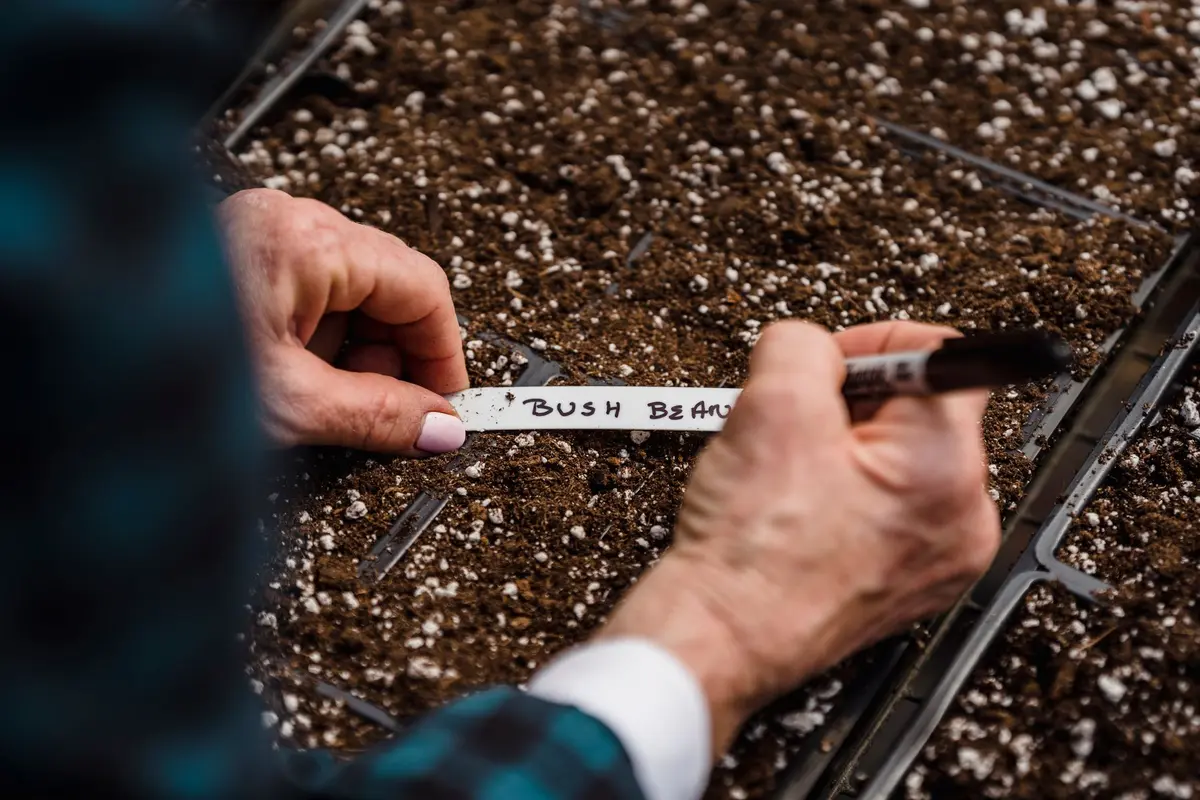 📘 Know-howHow to plan next year's garden from this year's harvestTurn this season's harvest record into next year's plan: pounds per 10 ft, grow more or less, row length for a goal, and which bed each crop moves to.Read the guide
 ✅ ChecklistHow to weigh and log your garden harvest without it becoming a choreA simple way to weigh every pick and keep a season harvest log: the scale, zeroing the basket, ounces to pounds, and the columns worth keeping.Read the guide
Common questions
Questions
How do I review my vegetable garden at the end of the season?
Add up each crop's pounds from the harvest log, divide by its feet of row, and compare with an extension average for the same row. Grade each crop, decide whether to grow it again, size next year's row from a pounds goal, and move each plant family to a different bed.
Source: N.C. Cooperative Extension Forsyth County, Garden Journal template, checked October 22, 2026; Mississippi State Extension, vegetable planting guide, checked October 21, 2026.
How do I know if my garden yield was good?
Scale an extension average to your row. Mississippi State Extension expects about 60 lb of bush snap beans per 100 ft, so 16 ft should give about 9.6 lb. 11 lb from that row is 115% of the average.
Source: Mississippi State Extension, vegetable planting guide, checked October 21, 2026.
How much should I plant next year?
Divide the pounds you want by this year's pounds per foot and round up. Beans that gave 11 lb from 16 ft need 30 ft of row for 20 lb. If you didn't weigh anything, use the extension average instead.
Source: Mississippi State Extension, vegetable planting guide, checked October 21, 2026.
Do I need to rotate crops in raised beds?
Iowa State Extension suggests keeping each plant family out of the same spot for 3 to 4 years and says three or four raised beds make rotation simple. With one or two beds, swap halves or beds each year; rotating as best you can still helps.
Source: Iowa State Extension, Crop Rotation in the Vegetable Garden, checked October 22, 2026.
What should I write down at the end of the season?
For each crop: the bed, the feet of row, the total pounds, the first and last pick dates, a grade and whether to grow it again. N.C. Extension's garden journal and UVM's 4-H record both use these columns.
Source: N.C. Cooperative Extension Forsyth County, Garden Journal template, checked October 22, 2026; UVM Extension, 4-H Gardening Project Record, checked October 22, 2026.
The next job on the shelf
More garden systems
 7 steps🧭 SystemRefresh border mulch: measure each bed, then buy only the gapMeasure the old layer in every bed before you order. One example yard needs 23 bags of 2 cu ft, not 45. The steps, the 3 inch limit and a free mulch record.Open the system
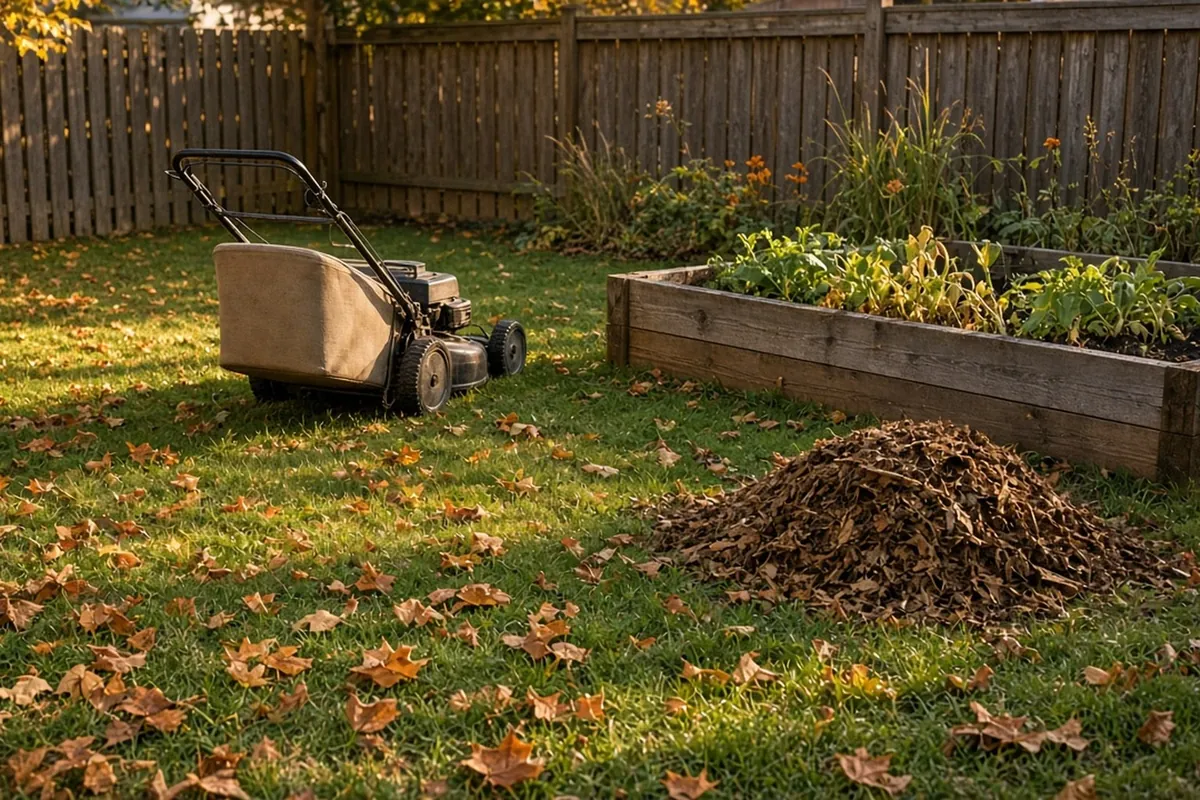 7 steps🧭 SystemTurn fall leaves into bed cover and mulch, and keep a tally of the bagsWhat to do with fall leaves: mow a thin layer into the lawn, shred the rest and spread 2 to 3 inches on beds. Free leaf haul tally to print.Open the system
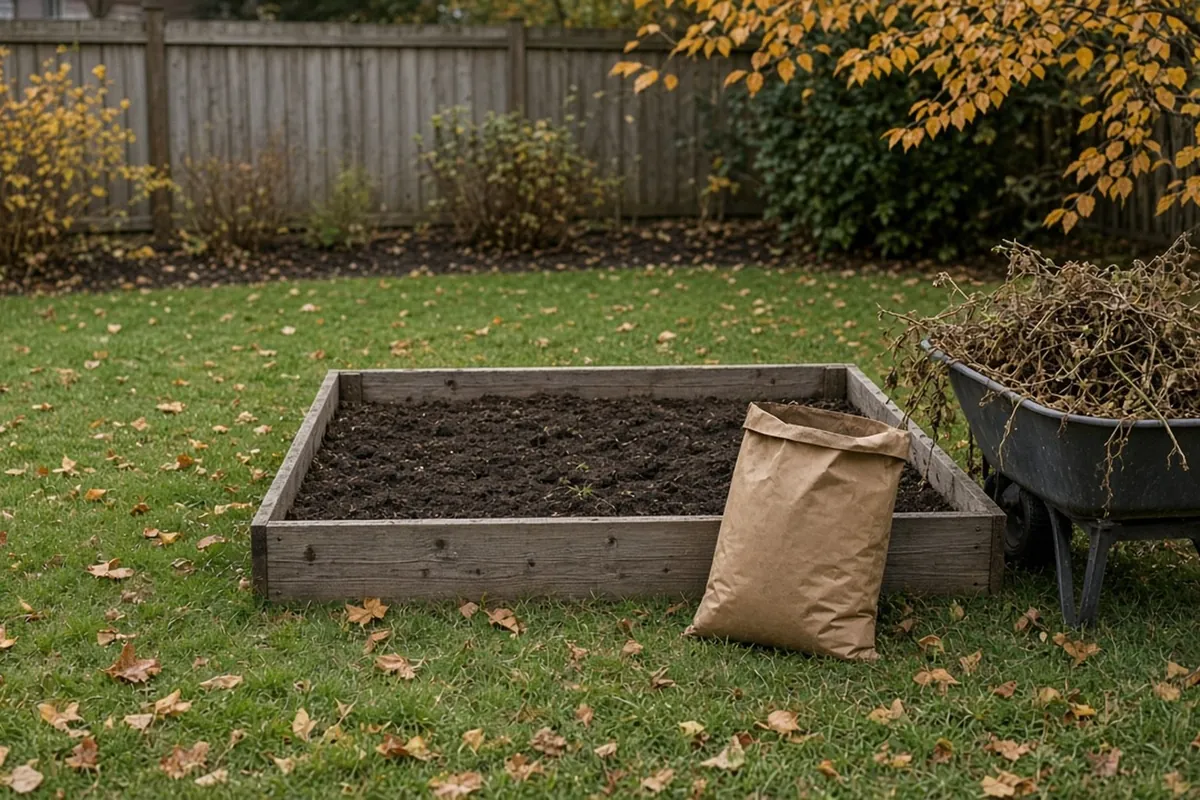 6 steps🧭 SystemFall raised bed reset: clear, top up and cover for winterPut a raised bed to bed in fall: clear finished plants, measure how far the soil sank, top it up with compost and cover it with leaves. Free checklist.Open the system
Sources
- Garden Journal (template with instructions), N.C. Cooperative Extension, Forsyth County Center. Checked October 22, 2026.
- Vegetable Gardens: Planting Guide, Mississippi State University Extension Service. Checked October 21, 2026.
- Crop Rotation in the Vegetable Garden, Iowa State University Extension and Outreach, Yard and Garden, published April 1, 2025. Checked October 22, 2026.
- Handbook 44 (2026), Appendix C. General Tables of Units of Measurement, National Institute of Standards and Technology (NIST), Office of Weights and Measures, published December 22, 2025. Checked October 22, 2026.
- 4-H Gardening Project Record, University of Vermont Extension (4-H), published April 15, 2014. Checked October 22, 2026.
- Garden Journal, University of Illinois Extension. Checked October 22, 2026.
Planning guide, not a guarantee. See every source on the site on the sources page. Spotted an error? Tell us.