📘 Know-howBeds5 min read
Are old seeds still good? How long seed keeps, and a 10-seed test
Quick answer
Often, yes. In cool, dry storage, University of Nebraska Extension gives onion and parsnip seed about 1 year, beans, peas and carrots about 3, and lettuce, cucumbers and radishes about 5. To know for sure, sprout 10 seeds on a damp paper towel. Illinois Extension's rule: 70 to 90% sprouted, sow a little thicker; under 70%, buy new seed.
Source: UNL Extension G2090, seed storage and germination, checked October 14, 2026; Illinois Extension, test seed viability (2017), checked October 14, 2026.

How long
How long vegetable seed keeps
Seed doesn't die on a date. It loses germination slowly, faster when it's warm and damp, slower when it's cool and dry. University of Nebraska Extension's storage guide lists how long each crop usually keeps under cool, dry conditions, and the range is wide: 1 year for onion, parsley and parsnip, 2 for pepper, okra and sweet corn, 3 for beans, peas, carrots, spinach and tomato, 4 for beets, squash and turnips, and 5 for lettuce, cucumbers and radishes.
Source: UNL Extension G2090, seed storage and germination, checked October 14, 2026.
The test
The 10-seed paper towel test
Start it in winter, a few weeks before you order, so the results are in when you fill out the order sheet. You need a paper towel, a zip bag, a marker and 10 seeds from each packet you want to check.
Source: Illinois Extension, test seed viability (2017), checked October 14, 2026.
Count out 10 seeds
Ten makes the math easy: each seed that sprouts is 10%.
Source: Illinois Extension, test seed viability (2017), checked October 14, 2026.
Dampen the towel
Wet half a paper towel and wring it out. It should be damp, not dripping, or the seeds can rot.
Source: UVM Extension, can old seeds still grow (2026), checked October 14, 2026; Illinois Extension, test seed viability (2017), checked October 14, 2026.
Fold, bag and label
Line the seeds up near one edge, fold the towel over them, slide it into the bag and write the crop and the date on it. Vermont Extension also suggests writing the date you expect sprouts: the start date plus the days to germination on the packet.
Source: UVM Extension, can old seeds still grow (2026), checked October 14, 2026.
Keep it warm
Illinois Extension says to keep the bag above 70°F; Nebraska Extension uses 70 to 75°F. The top of the refrigerator is a warm spot in many kitchens. Check every few days that the towel is still damp.
Source: Illinois Extension, test seed viability (2017), checked October 14, 2026; UNL Extension G2090, seed storage and germination, checked October 14, 2026; UVM Extension, can old seeds still grow (2026), checked October 14, 2026.
Count the sprouts
Open it after the packet's days to germination, or after 7 to 10 days if you don't know them. Count every seed with a root showing.
Source: Illinois Extension, test seed viability (2017), checked October 14, 2026.
- 10seeds per test, each one worth 10%Illinois Extension, test seed viability (2017), October 14, 2026
- 70%below this, Illinois Extension says buy newIllinois Extension, test seed viability (2017), October 14, 2026
- 1 yronion and parsnip seed, cool and dryUNL Extension G2090, seed storage and germination, October 14, 2026
- 5 yrlettuce, cucumber and radish seedUNL Extension G2090, seed storage and germination, October 14, 2026
The count
What to do with the result
Illinois Extension draws the line at 70%. From 70 to 90% sprouted, the seed is fine, so sow a little thicker than normal. Under 70%, buy new seed. Vermont Extension is a bit looser and suggests new seed if fewer than half sprout. Either way, the count is your germination rate, and it tells you how much of that packet to plan on.
Source: Illinois Extension, test seed viability (2017), checked October 14, 2026; UVM Extension, can old seeds still grow (2026), checked October 14, 2026.
The rate changes the order a lot. A 4 by 8 ft bed with three 8 ft rows of beans at 2 inches has 144 spots. At 80%, you need 180 seeds on hand. At 60%, you need 240. Below 70%, you're usually better off buying fresh seed than counting on that many from an old packet.
Source: Clemson HGIC 1256, planning a garden, checked October 14, 2026.
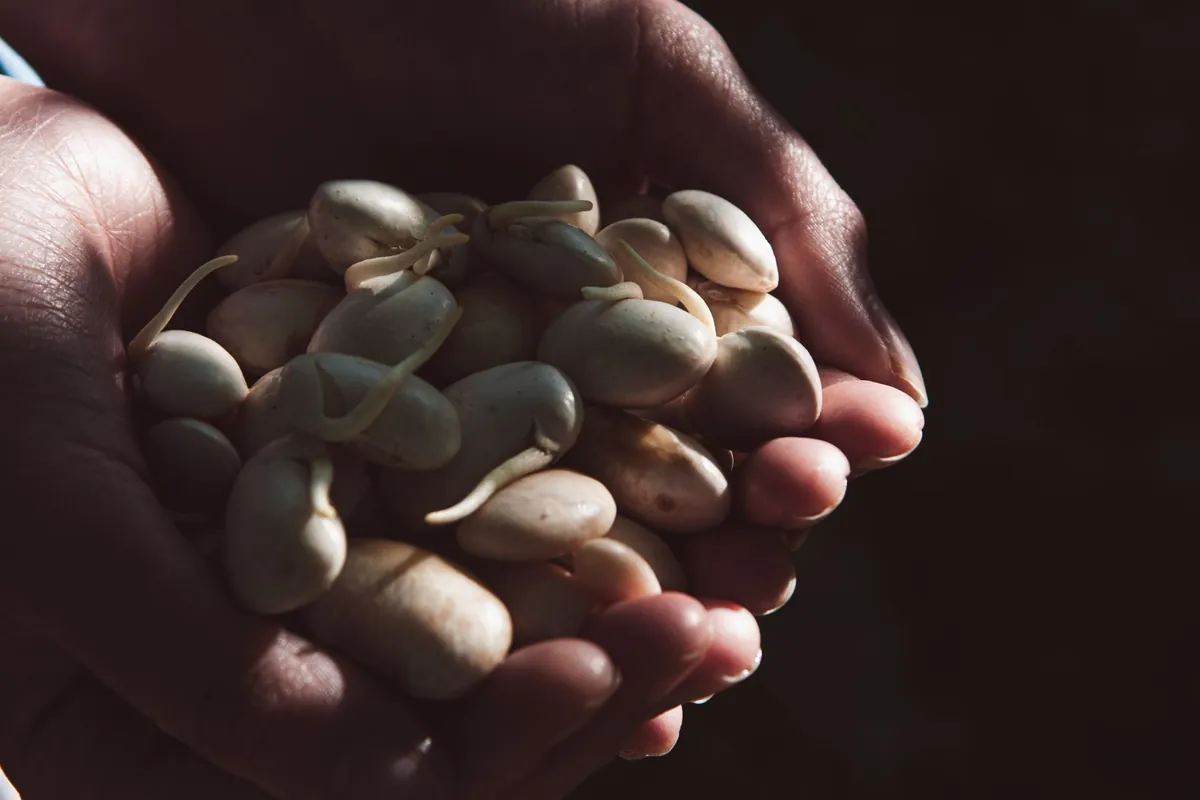
Storage
Make next year's seed last
Print it, tick it off
Seed test log
One line per packet you test. Start the tests a few weeks before you order.
- Crop, variety and the year on the packet
- Date started and date expected to sprout
- Where the bag was kept, and the temperature
- Seeds sprouted out of 10
- Rate (sprouted × 10%)
- Keep and sow thicker, or buy new
- Seeds left in the packet after the test
What people learn the second year
Tips and tricks
- Start with the big seed. Beans, peas and corn are easy to count, so test them first. They also take up the most of an order.
- Test several crops at once. Put each crop in its own labeled bag and keep them in a box together, so they stay at the same temperature.
- Toss the test seeds. Seed sprouted in the test won't fit your sowing schedule. Count it, write the result down, and put it in the compost.
- Retest every winter. A packet that tested at 80% last year will test lower this year. Write each year's result on the packet.
Common questions
Questions
How long do vegetable seeds last?
In cool, dry storage, University of Nebraska Extension lists about 1 year for onion and parsnip, 2 for pepper and sweet corn, 3 for beans, peas, carrots and tomato, 4 for beets and squash, and 5 for lettuce, cucumbers and radishes.
Source: UNL Extension G2090, seed storage and germination, checked October 14, 2026.
How do I test seeds with a paper towel?
Put 10 seeds on a damp, not dripping, paper towel, fold it, seal it in a labeled bag and keep it above 70°F. After the packet's days to germination, or 7 to 10 days, count the sprouts. Each sprouted seed is 10%.
Source: Illinois Extension, test seed viability (2017), checked October 14, 2026.
What germination rate is too low?
Illinois Extension says to buy new seed if fewer than 70% sprout, and to sow a little thicker at 70 to 90%. Vermont Extension's line is lower: consider new seed if fewer than half sprout.
Source: Illinois Extension, test seed viability (2017), checked October 14, 2026; UVM Extension, can old seeds still grow (2026), checked October 14, 2026.
Can I plant seeds past the date on the packet?
Yes, if they still sprout. Seed loses germination slowly rather than on a set day, so run the 10-seed test and plan with the rate you get.
Source: UNL Extension G2090, seed storage and germination, checked October 14, 2026; Illinois Extension, test seed viability (2017), checked October 14, 2026.
The arithmetic, done for you
Tools for this job
- 🌱 CalculatorSeed quantity calculatorHow many seeds your rows take, how many to keep on hand once germination is allowed for, and how many packets or ounces to order.Open the tool
- 🧺 SectionAll beds toolsPlan a wooden raised bed: how many boards to buy, where to cut them, how tall the bed ends up and how much soil it will hold.See the section
Keep reading
More guides
 ✅ ChecklistHow to draw a garden bed map you'll actually use next yearMeasure the beds, pick a scale like 1 square = 1 foot, and mark what went where and when. Next spring the map tells you where each crop family goes.Read the guide
 📘 Know-howHow tall to build a raised bed: real board heights and the depths extension pages giveTwo 2x6 boards make an 11 inch bed, enough on open ground for most crops. When to go to 16 1/2 or 24 inches, and what each extra board costs in lumber and soil.Read the guide
 📘 Know-howNominal vs actual lumber sizes: what a 2x6 really is when you build a bedA 2x6 is 1 1/2 by 5 1/2 inches. The real size of every 2x board under the federal lumber standard, what it does to bed height and end cuts, and a lumber list.Read the guide
Sources
- Vegetable Garden Seed Storage and Germination Requirements (G2090), University of Nebraska-Lincoln Extension, published June 1, 2011. Checked October 14, 2026.
- Test seed viability (ILRiverHort blog), University of Illinois Extension, published February 3, 2017. Checked October 14, 2026.
- Can old seeds still grow?, University of Vermont Extension, published January 16, 2026. Checked October 14, 2026.
- Planning a Garden (HGIC 1256), Clemson Cooperative Extension, Home & Garden Information Center, published February 12, 2021. Checked October 14, 2026.
Planning guide, not a guarantee. See every source on the site on the sources page. Spotted an error? Tell us.