📘 Know-howBeds4 min read
How to store leftover seed over winter so it still comes up in spring
Quick answer
Keep seed cool, dry and dark. University of Delaware Extension's rule: the temperature in °F plus the relative humidity in % should stay under 100, and 40°F with 30% humidity is better still. Seal the packets in a jar, keep the jar in the fridge or a cool closet, and let it warm to room temperature before you open it.
Source: UD Extension, storing vegetable seed (2011), checked October 20, 2026; UVM Extension, can old seeds still grow (2026), checked October 14, 2026.

The problem
Why leftover seed dies in storage
Most half-used packets end up in a kitchen drawer, a shed or a box in the garage. Seed doesn't die there all at once. It loses germination a little at a time, and heat and damp make it go faster. A packet left in a hot shed all summer can come up thin the next spring, while the same seed kept cool and dry would have been fine.
University of Delaware Extension puts numbers on it. Seed loses half its storage life for each 9°F rise in temperature, and half again for each 1% rise in the seed's own moisture. Heat and moisture work together, so a warm, humid spot is the worst place for a seed box.
Source: UD Extension, storing vegetable seed (2011), checked October 20, 2026.
The rule
The 100 rule for a storage spot
Delaware Extension's test for a storage spot is simple: add the temperature in °F to the relative humidity in %, and keep the total under 100. Its examples are 50°F with 50% humidity and 40°F with 60%, both right at the line. For seed you want to keep longer, it gives 40°F and 30% humidity for most seeds, which adds up to 70.
Source: UD Extension, storing vegetable seed (2011), checked October 20, 2026.
- < 100°F plus % humidity for good storageUD Extension, storing vegetable seed (2011), October 20, 2026
- 40°Fwith 30% humidity for longer storageUD Extension, storing vegetable seed (2011), October 20, 2026
- 9°Fwarmer halves storage lifeUD Extension, storing vegetable seed (2011), October 20, 2026
- 1%more seed moisture also halves itUD Extension, storing vegetable seed (2011), October 20, 2026
A small thermometer with a humidity reading tells you where your spots stand. Leave it in the closet, basement or fridge for a day, then add the two numbers. If a spot comes out over 100, pick a cooler or drier one, or put the seed in a sealed jar so the room's damp air can't reach it.
Source: UD Extension, storing vegetable seed (2011), checked October 20, 2026.
Step by step
Put the seed away for winter
Sort and label
Gather every packet, fold the open ones shut and write the year on any packet that doesn't show one. Note how much is left in each.
Seal them in a jar
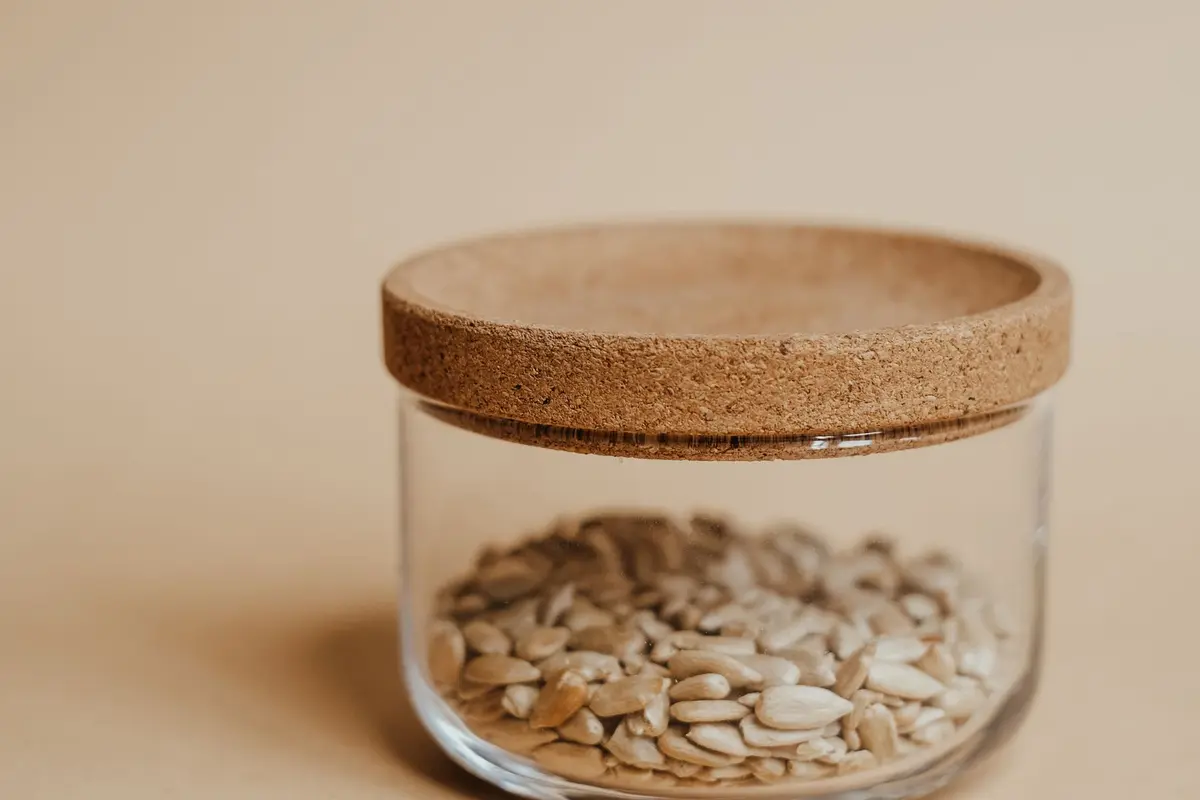
Put the packets in a glass jar or another container with a tight lid. Vermont Extension says to use an airtight container if the seed goes in the refrigerator.
Source: UVM Extension, can old seeds still grow (2026), checked October 14, 2026.
Pick a cool, dark spot
Vermont Extension calls about 40°F the best storage temperature, and both Vermont and Delaware say to keep seed in the dark. A refrigerator shelf or a cool interior closet works. Delaware warns against uninsulated metal buildings for summer storage.
Source: UVM Extension, can old seeds still grow (2026), checked October 14, 2026; UD Extension, storing vegetable seed (2011), checked October 20, 2026.
Warm before opening
When you take the jar out, leave it closed until it reaches room temperature, so damp air doesn't settle on cold seed. Take out what you need and put the rest back soon.
Test before you count on it
In January, sprout 10 seeds from each older packet on a damp paper towel. The count out of 10 is the germination rate to plan with.
Source: Illinois Extension, test seed viability (2017), checked October 14, 2026.
How long
How many years good storage buys
Even in good storage, seed doesn't last the same time for every crop. University of Nebraska Extension's table for cool, dry storage gives onion, parsley and parsnip about 1 year, pepper and sweet corn 2, beans, peas, carrots and tomato 3, and lettuce, cucumbers and radishes 5. Buy the short-lived ones fresh and test the rest.
Source: UNL Extension G2090, seed storage and germination, checked October 14, 2026.
Print it, tick it off
Seed storage checklist
Run through it once in fall when the last packets come in from the garden.
- Every packet labeled with its year
- Open packets folded and closed
- Packets sealed in a jar or tight-lidded box
- Storage spot checked: °F plus % humidity under 100
- Jar kept in the dark, away from a hot shed or garage
- Short-lived seed (onion, parsnip) marked to buy fresh
- Germination test planned for January
What people learn the second year
Tips and tricks
- One jar per season. Keep this year's leftovers together in one jar. Next winter you'll know at a glance which packets are a year old.
- Write the count on the packet. Jot down roughly how many seeds are left when you put the packet away. The winter order goes faster when you don't have to count again.
- Keep the jar where you'll see it. A jar on the back of a fridge shelf gets forgotten. Put it in front, or tape a note on the door.
- Don't store seed by the furnace. Warm rooms cut storage life fast: by Delaware Extension's rule, a spot 18°F warmer leaves a quarter of the life. (UD Extension, storing vegetable seed (2011))
Common questions
Questions
Can I store seeds in the refrigerator?
Yes. Vermont Extension gives about 40°F as the best storage temperature and says to use an airtight container in the fridge. Let the jar warm to room temperature before you open it.
Source: UVM Extension, can old seeds still grow (2026), checked October 14, 2026.
Is the garage OK for storing seeds over winter?
Check it with the 100 rule from Delaware Extension: the temperature in °F plus the relative humidity in % should stay under 100. A cold, dry garage can pass in winter, but seed left there into summer heat loses storage life fast.
Source: UD Extension, storing vegetable seed (2011), checked October 20, 2026.
Can I freeze vegetable seeds?
Delaware Extension says freezing works very well if the seed is dry, but wet seed can be damaged and repeated freezing and thawing harms it. Take out only what you need each time.
Source: UD Extension, storing vegetable seed (2011), checked October 20, 2026.
How long will stored seeds last?
It depends on the crop. Nebraska Extension's table for cool, dry storage gives onion and parsnip about 1 year, beans, peas, carrots and tomato about 3, and lettuce, cucumbers and radishes about 5.
Source: UNL Extension G2090, seed storage and germination, checked October 14, 2026.
The arithmetic, done for you
Tools for this job
- 🌱 CalculatorSeed quantity calculatorHow many seeds your rows take, how many to keep on hand once germination is allowed for, and how many packets or ounces to order.Open the tool
- 🧺 SectionAll beds toolsPlan a wooden raised bed: how many boards to buy, where to cut them, how tall the bed ends up and how much soil it will hold.See the section
Keep reading
More guides
 📘 Know-howAre old seeds still good? How long seed keeps, and a 10-seed testHow many years vegetable seed keeps in cool, dry storage, how to sprout 10 seeds on a paper towel, and what to do with the count.Read the guide
 ✅ ChecklistHow to draw a garden bed map you'll actually use next yearMeasure the beds, pick a scale like 1 square = 1 foot, and mark what went where and when. Next spring the map tells you where each crop family goes.Read the guide
 📘 Know-howHow tall to build a raised bed: real board heights and the depths extension pages giveTwo 2x6 boards make an 11 inch bed, enough on open ground for most crops. When to go to 16 1/2 or 24 inches, and what each extra board costs in lumber and soil.Read the guide
 📘 Know-howNominal vs actual lumber sizes: what a 2x6 really is when you build a bedA 2x6 is 1 1/2 by 5 1/2 inches. The real size of every 2x board under the federal lumber standard, what it does to bed height and end cuts, and a lumber list.Read the guide
Sources
- Storing Vegetable Seed (Weekly Crop Update), University of Delaware Cooperative Extension, published May 6, 2011. Checked October 20, 2026.
- Can old seeds still grow?, University of Vermont Extension, published January 16, 2026. Checked October 14, 2026.
- Test seed viability (ILRiverHort blog), University of Illinois Extension, published February 3, 2017. Checked October 14, 2026.
- Vegetable Garden Seed Storage and Germination Requirements (G2090), University of Nebraska-Lincoln Extension, published June 1, 2011. Checked October 14, 2026.
Planning guide, not a guarantee. See every source on the site on the sources page. Spotted an error? Tell us.